The first battles in Christian history weren’t fought with swords. They were fought with syntax. With theology. With endless, exhausting debates held in stuffy rooms across the Roman Empire.
These arguments defined God. They defined Jesus. They decided if Mary was the Mother of God or just a human mother. And they determined whether you could paint a picture of a saint or if that was idolatry.
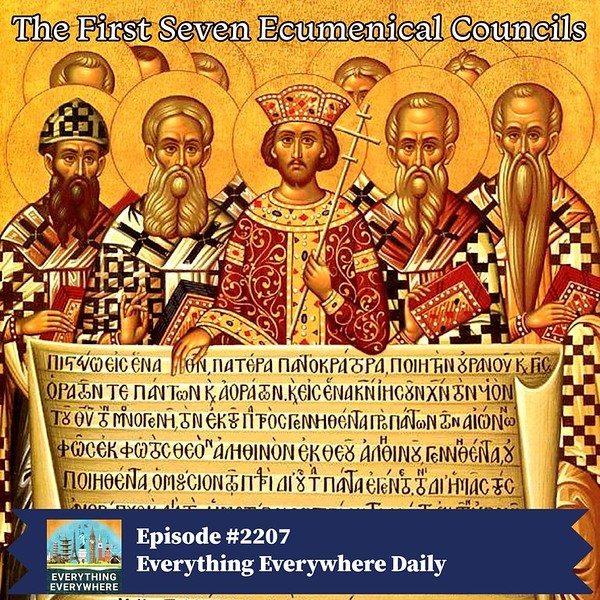
These weren’t casual discussions. These were the First Seven Ecumenical Councils.
Over a span of roughly 750 years, bishops gathered to settle disputes that still rip through Christianity today. The decisions made in Nicaea, Constantinople, Ephesus, Chalcedon, and elsewhere created the theological bedrock for Catholics, Orthodox, and most Protestants.
Here is how seven meetings shaped 2 billion people’s faith.
What Actually Counts as an Ecumenical Council?
Christianity didn’t start as a unified monolith. In the early centuries, it was a loose collection of communities, each led by a local bishop. These bishops traced their authority back to the apostles, a chain known as apostolic succession.
When a theological disagreement turned into a firestorm, they didn’t vote online. They called an ecumenical council.
The term “ecumenical” means universal. Unlike a local synod, these councils gathered bishops from across the known Christian world. Their decisions were meant to be binding on everyone. If you weren’t invited, you were arguably not part of the mainstream church.
There were seven of them before the world changed too much for this model to work.
A brief note on the pre-game: The Council of Jerusalem around 49 AD isn’t usually counted in the seven, but it set the template. It decided Gentile Christians didn’t need to be circumcised. That small decision separated Christianity from Judaism entirely.
The First Council of Nicaea: Defining the Trinity
When: 325 AD
Where: Nicaea (modern-day Iznik, Turkey)
Who called it: Emperor Constantine
The first major crisis was Arianism. Arius, a priest, argued that Jesus was a created being—subordinate to God the Father. He wasn’t fully divine. He was, essentially, a very high-ranking angel.
Constantine hated disunity. He called the bishops together to fix this.
The result? The Council rejected Arius. They affirmed that the Son was homoousios —of the same substance as the Father. Fully divine. Eternal.
This council produced the original Nicene Creed. It also standardized the date of Easter (a surprisingly complex math problem) and set down disciplinary rules for clergy.
Today, if you are a Catholic, Orthodox, Anglican, Lutheran, Methodist, Presbyterian, or Baptist, you are “Nicene.” You accept this core theology.
The First Council of Constantinople: The Holy Spirit Steps In
When: 381 AD
Where: Constantinople
Who called it: Emperor Theodosius I
Fifty-six years later, the debate wasn’t over Jesus anymore. It was about the Holy Spirit.
Some groups argued the Spirit was a force, not a person. Others still clung to Arianism. Theodosius called this council to tighten the screws.
They expanded the Nicene Creed. The new version, the Niceno-Constantinopolitan Creed, explicitly affirmed the divinity of the Holy Spirit, placing the Spirit alongside the Father and the Son.
This is the creed recited in most churches today. It solidified the Trinitarian structure: three persons, one God.
The Council of Ephesus: Is Mary the Mother of God?
When: 431 AD
Where: Ephesus (modern-day Turkey)
Who called it: Emperor Theodosius II
The third council tackled a question that sounds simple but is theological dynamite: What do you call Mary?
Nestorius, the Patriarch of Constantinople, objected to the title Theotokos, meaning “God-bearer” or “Mother of God.” He preferred Christotokos, “Christ-bearer.” Why? He felt that calling Mary the Mother of God confused her human role with Jesus’ divine nature. He saw Christ’s human and divine natures as separate entities loosely joined.
The Council of Ephesus condemned Nestorius.
They ruled that Jesus was one unified person, fully human and fully divine. Therefore, Mary bore the person who is God. She is rightly called Theotokos.
The unintended consequence: The Church of the East, often associated with Nestorianism, split from the imperial church. These Christians flourished outside the Empire, spreading into Persia, India, China, and Central Asia. They remain distinct today.
The Council of Chalcedon: Two Natures, One Person
When: 451 AD
Where: Chalcedon (near modern Istanbul)
Who called it: Emperor Marcian
Ephesus didn’t end the confusion. If Jesus wasn’t two separate persons, how did the divine and human coexist? Did the divine swallow the human?
Chalcedon answered this. They declared that Christ exists in two natures, divine and human, “without confusion, change, division, or separate.”
It’s a tightrope walk. He isn’t two people. But he isn’t a blended hybrid, either.
The split: This definition alienated the Oriental Orthodox churches (Coptic, Armenian, Syriac, Ethiopic, Eritrean). They rejected Chalcedon’s wording, feeling it drifted toward Nestorianism. This is the Oriental Schism, which still exists.
The Second Council of Constantinople: The Three Chapters
When: 553 AD
Where: Constantinople
Who called it: Emperor Justinian I
Justinian wanted to fix the Oriental Schism. He hoped by condemning three specific theological writings—the Three Chapters —associated with Nestorian-leaning theologians, he could woo the anti-Chalcedonians back to the fold.
He didn’t.
The council reaffirmed Chalcedon while trying to clarify that Chalcedon didn’t support Nestorius. The West (Rome) was unhappy, seeing it as a backtrack. The East remained split. Justinian’s diplomatic effort failed.
The Third Council of Constantinople: Two Wills
When: 680–681 AD
Where: Constantinople
Who called it: Emperor Constantine IV
The debate shifted to volition. Did Christ have one will or two?
Monothelitism argued that Christ, having one person, must have only one will—a divine will that overrode his human nature. This was largely a political compromise to try and keep the Empire together during times of crisis.
The Council said no. Jesus has two wills, one divine and one human. They correspond to his two natures. His human will freely submitted to the divine, but it was still fully human.
Controversy: The council condemned Pope Honorius I for supporting Monothelitism. This later became a nightmare for Catholic theology regarding papal infallibility. How can the Pope be infallible if he was condemned as a heretic?
The Second Council of Nicaea: The Icons
When: 787 AD
Where: Nicaea
Who called it: Empress Irene (regent)
The final of the seven addressed Iconoclasm. Should Christians use images in worship?
Byzantine emperors and military leaders had argued that icons were idolatry. They destroyed them.
The Council restored the icons. They made a crucial distinction: veneration (honor) is given to the image; worship (latria) is given to God alone. Because Christ became visible human flesh, he can be depicted. To deny the icon is to deny the Incarnation.
This decision is central to Eastern Orthodox worship today. Catholics accepted it too. But centuries later, many Protestants would reject it again during the Reformation.
Why Only Seven? The End of an Era
So why no Eighth Council? Why did the pattern stop?
It wasn’t a lack of disagreements. It was a collapse of structure.
The first seven councils worked because of the Roman (and later Byzantine) Empire. The Emperor could summon bishops. He provided security. He enforced the results. The state and the church were intertwined.
Then the world broke apart.
- Political Fragmentation: The Western Roman Empire fell. The Byzantine Empire weakened. No single ruler could command bishops from across the entire Christian world.
- The Splits: Ephesus and Chalcedon had already fractured the church. By 787, “universal” didn’t mean everyone. It meant those still under Byzantine or Latin influence.
- Islamic Expansion: The rise of Islam changed the map. Alexandria, Antioch, and Jerusalem—the ancient seats of bishops—came under Muslim rule. The geography of Christianity shifted north and west.
- The Great Schism: By 1054, the divide between Greek-speaking Orthodoxy and Latin-speaking Catholicism was unbridgeable. They no longer recognized each other’s authority.
After 787, the Catholic Church held more councils they called “ecumenical” (like Trent, Vatican I, Vatican II), totaling 14 more. The Orthodox do not recognize them as universal.
The Council That Wrote the Bible
There was one other council that matters immensely, though it wasn’t “ecumenical.”
The Council of Hippo in 393 AD, in North Africa.
It wasn’t universal, but it did something huge: it listed the books of the Bible.
At the time, there were many texts circulating—apocrypha, gnostic gospels, letters. Which ones were scripture? Hippo (and the later Council of Carthage in 397) settled the canon for the Western church. It relied on texts already in use with ties to the apostles.
This list became the basis for the Protestant and Catholic Old and New Testaments (though they differ on a few Deuterocanonical books).
The Legacy of Seven
These seven councils established the rules of the game.
They created the idea that doctrine is settled by collective leadership, not just one bishop or one emperor. They defined the Trinity, the person of Christ, and the nature of the Church.
But they also created the fractures we see today. The Oriental Orthodox, the Eastern Orthodox, the Catholics, and the various Protestant denominations all trace their lineage back to these seven moments of decision and division.
The arguments didn’t stop. They just moved to new venues.
What happens when the empire falls? When there is no Emperor to force the bishops into a room?
History shows that we still argue. We still convene. We just call the meetings different things now.