Most people only see Catania in February. The streets vanish under pilgrims. Hundreds of thousands descend for the feast of Santa Agatha. It’s loud. It’s chaotic. It’s electric. But the real treasure? It waits silently, hidden right next to the Duomo, for the other 11 months of the year.
The Museo d’Arte Sacra di Catania isn’t a gallery of detached aesthetic appreciation. It’s a physical timeline. You walk through centuries of devotion. The spaces are packed with silver reliquaries. Sculpted saints. Icons. Heavy liturgical gold. These aren’t just “art objects.” They are the tangible proof of how deeply the patron saint of the city is woven into its DNA.
Where is the Museo d’Arte Sacra in Catania?
If you are wondering where to find this quieter side of Sicily’s capital, look no further than the cloisters adjacent to the Catania Cathedral. The museum occupies the historic bishop’s palace. This location matters. It places the artifacts exactly where they belong—intimately tied to the seat of the church that has guided Catania since the Middle Ages. You aren’t visiting a sterile white box in a modern district. You are inside the heartbeat of the old city.
How the Festival Changed the Museum’s Approach
Why does this specific museum exist? Because during the February festivities, the fercolo (the silver cart) disappears into the crush. You can’t see it. You can’t appreciate its weight. The Museo d’Arte Sacra solved this problem.
It allows visitors to get within arm’s reach of the fercolo itself. This magnificent silver structure, used to carry the relics of Saint Agatha through the city’s narrow, steep streets, is the museum’s crown jewel. Up close, the craftsmanship stops being a blur and becomes clear. You can count the chisels marks. You can see the sorrow in the faces of the angels. It transforms the object from a moving vehicle into a static masterpiece.
Atmosphere and Design in a Sicily Treasure House
Walking through these galleries feels less like reading a textbook and more like stumbling into a secret. The acoustics shift. Noise from the busy Via Etnea fades into a hushed reverence. Some rooms are staged like theater sets. Others feel like forgotten chapels where the dust motes are dancing in silence.
There is no “perfect balance” here. No curated, air-conditioned neutrality. Instead, you get a sense of weight. Of history. The curators didn’t try to make the sacred art feel “accessible” in a modern, watered-down way. They present it as it is: powerful, intimidating, and alive. This isn’t distant history. It is living tradition.
The View That Defines the Experience
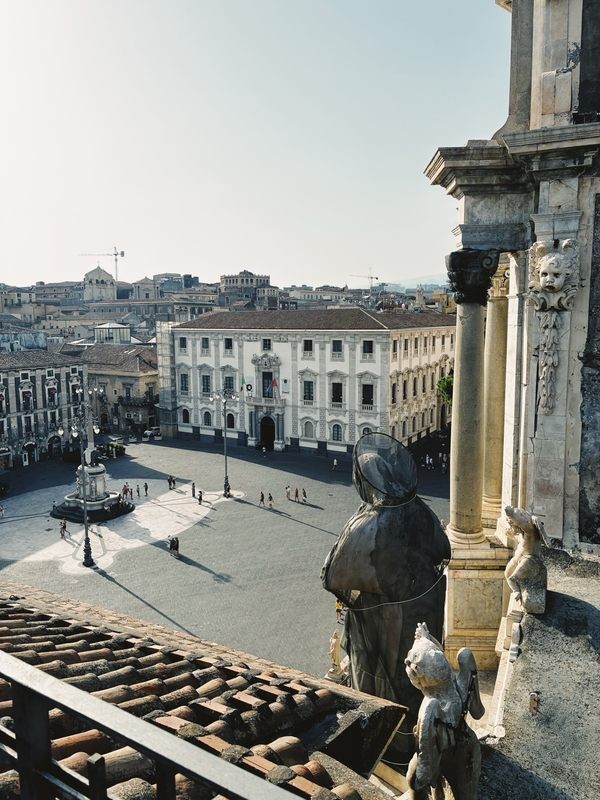
The visit concludes with a deliberate shift in perspective. You exit to the panoramic terraces. Suddenly, the small, delicate objects seem vast.
From this vantage point, you see the layout of the rituals below. Piazza del Duomo sprawls out. The Porta Uzeda gateway stands guard. The terracotta roofs of Catania roll toward the horizon, where Mount Etna looms like a sleeping giant. This view isn’t just