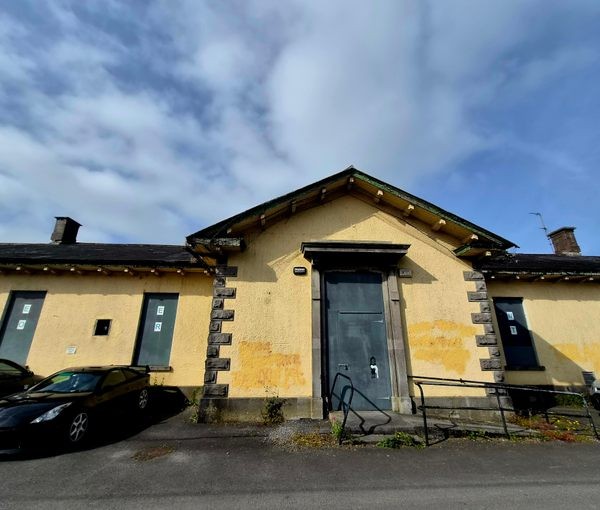
Tuam Railway Station opened in 1860 as part of the Waterford, Limerick and Western Railway. It quickly became one of the most important railway hubs in the west of Ireland.
Passenger services ended in 1976 as part of a nationwide rationalisation of its railway network, although freight trains continued using it until 1993. Since then, the station has stood largely abandoned, with its Victorian buildings gradually falling into disrepair. Despite this, many original features—including its distinctive wrought-iron lattice footbridge, platform canopies, goods facilities, and water tower —still survive, making Tuam one of Ireland’s most complete surviving historic railway stations. There have been proposals to restore the railway as part of the Western Rail Corridor, but the station remains closed today, waiting for a future that hasn’t quite arrived.
A Fading Victorian Gem
The architecture tells a story. The Victorian era buildings still stand, though they lean slightly under the weight of time. The wrought-iron lattice footbridge is a standout feature. It’s not just a crossing; it’s a relic of a time when trains moved at a different pace. Platform canopies once protected travelers from the relentless Irish rain. Now, they shelter nothing but dust and memory.
The water tower remains, too. A silent sentinel overlooking the tracks. These elements combine to make Tuam’s station unique. It’s one of Ireland’s most complete surviving examples of its kind. Few stations retain such a cohesive set of historic railway features. The goods facilities are still visible. They hint at the bustling commerce that once flowed through this town.
The Slow Fade: From Hub to Heritage Site
Why did it close? The answer lies in the broader nationalisation of transport. Passenger services ended in 1976. This was part of a larger trend across the country. Railways were being scaled back. Freight trains continued to use the station for a few more years, until 1993. Then, the tracks fell silent.
The disrepair began almost immediately. Without regular maintenance, Victorian-era structures succumbed to the elements. But the core remains intact. This is rare. Many stations were demolished. Others were