The candles don’t flicker. They hold their ground.
Hundreds of them arranged in tight, concentric circles. Bodies sit still in the dark. This is Auroville on New Year’s Eve. I recognize a friend. He grabs my hands with that intense, feverish warmth you only get in places built on belief.
“You made it,” he says. Not a question. A fact.
He points toward the beach outside Puducherry. We ride motorbikes through the southern Indian night. Banyan trees loom like silent sentinels. We hit a wild stretch of sand. Driftwood burns in a bonfire. The flames catch the faces of young travelers. Some are German. Some are Indian. Most are speaking in a broken, beautiful mix of English and gestures. They talk about yoga. About ashrams. About India as if it were a religion they invented yesterday.
Then a skinny guy in shorts, cross-legged on the sand, drops a bomb.
“This place is actually falling apart.”
The smiles vanish. Auroville doesn’t do conflict. It does harmony. It does utopia. But the fire crackles, and the truth hangs there, heavier than the smoke.
The Experiment That Started in 1968
Auroville wasn’t supposed to be a city. It was supposed to be a consciousness.
Founded in 1968 by Mirra Alfassa—known as ‘The Mother’—and based on the philosophy of Sri Aurobindo. The goal? A universal township. No borders. No religion. No ownership. Just humanity, symbolically mashed into one organism.
They poured soil from 43 countries into a ceremonial urn. Concrete? No. They created a 7.7-square-mile forest community. Experimental homes. Dusty paths. Farms. The land is held by the Auroville Foundation, a government-appointed body. Technically. But in theory, it belongs to no one.
It was meant to be a laboratory. A place to prove humans could evolve beyond greed. Beyond ego.
So why does it feel like it’s breaking?
The Pioneer Who Built It All
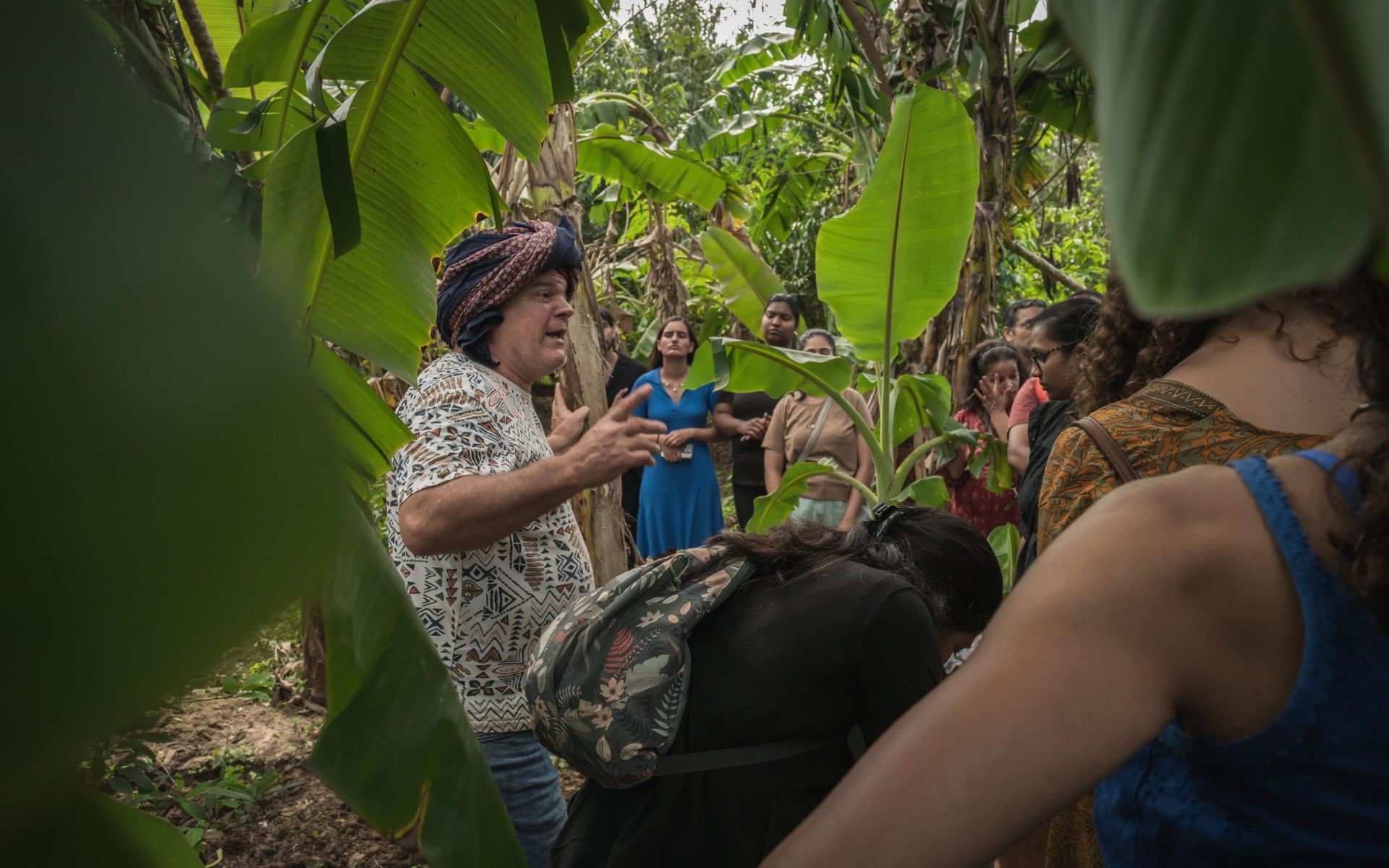
Frederick Schulze Buxloh built Auroville’s very first house. He arrived in 1959. A restless German kid. Obsessed with Hesse and Schopenhauer. He took a cargo ship to India because he had nowhere else to go.
He met The Mother.
“She looked into my eyes,” Buxloh tells me years later. “Everything collapsed. I thought I was arrogant. I feared nothing. Then the masks fell off.”
They were hippies. Spiritual seekers. Poor. Buxloh describes the early days with a fierce nostalgia. Dry land. Lunar landscape. They planted trees. Thousands of them. They built rainwater harvesting tanks and earthen dams. Water came back to the wells. The forest grew.
“We transformed a wasteland,” he says.
Today, the population sits at around 3,500. The original plan by French architect Roger Anger called for 50,000. Half of one percent of the vision realized.
When the Bulldozers Came
The cracks started showing in December 2021.
Bulldozers rolled into the Evergreen Forest. Not a metaphor. Actual mechanical teeth tearing into roots. They were building a radial road. Expanding the city.
Natasha Storey, a resident of the Evergreen community, stood in front of the machines. She asked them to stop. She cited the decisions of the Residents’ Assembly. The body made up of locals 18 and older. The body that’s supposed to have a say.
They didn’t stop.
Dr. Jayanti Ravi had given the order. She was the new Secretary to the Governing Board. Appointed by the Central Government of India earlier that year. The process bypassed the community. The greenlight came from the top down.
This is where the Auroville Foundation Act comes into play. The law is supposed to ensure a triad of power:
- The Residents’ Assembly.
- The Governing Board.
- The International Advisory Council.
They’re supposed to work together. In practice, Dr. Ravi sidelined the assembly. She bypassed the elders.
Control From The Top
Inside the Foundation offices, people shut down fast.
A European official walks me to the door. He’s pale. Whispers, “We can’t say anything against the foundation. We don’t have the right to discuss this.”
The mood is suffocating.
Reports are trickling in about centralized control. Email accounts changed without warning. Admin access stripped. And then there’s the visas. Auroville has its own special visa category for long-term residents. India’s immigration office issues the stamps, but you need a recommendation letter from the Foundation Secretary to get one.
Some say the letter is being withheld.
Even Buxloh, the pioneer, has had his renewal denied.
Is this what utopia looks like in 2024? Or just a new form of bureaucracy wearing spiritual clothes?
The Verdict
Crisis, Buxloh says, is just a trigger.
“Every crisis can be useful. These are the moments that accelerate evolution,” he muses, flipping through an old photobook of the place from 1968 to 2018. “We learned not to possess. We learned love without possession.”
He looks at me. Really looks at me.
“Maybe the time has come to carry this beyond Auroville itself. There are other places now. Other experiments. The experience won’t be lost.”
It’s an open ending. The town is still here. The trees are still green. But the center of gravity has shifted.
I walk through the dusty paths again. The silence isn’t meditative anymore. It’s waiting. For what? I’m not sure.