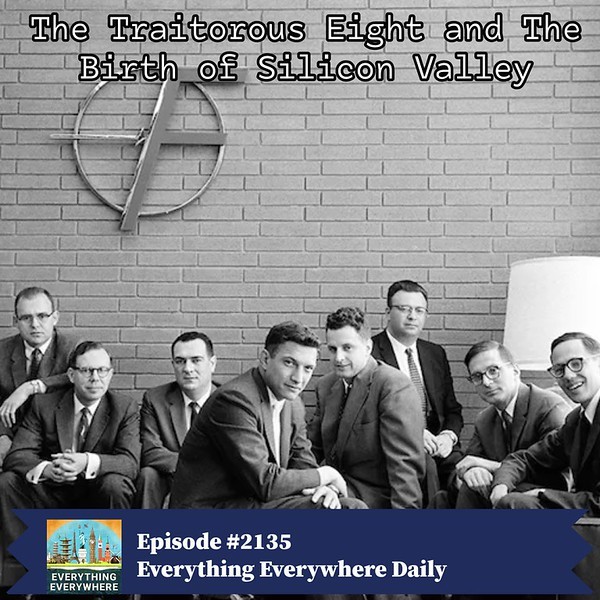
In 1958, eight guys walked out on a Nobel Laureate. They quit in a group. A scandal in the making.
It sounds like petty workplace drama. It was not. That mass resignation sparked the explosion of tech we live in. A chain reaction. From transistors to your phone, it started with a bad relationship.
The Origin of Valley
Silicon Valley is real. It’s south of San Francisco. Santa Clara Valley.
Think Mountain View. Sunnyvale. Palo Alto. Cupertino.
Today it’s the global HQ of tech. Trillions in value. But why there? Why not Chicago? Detroit?
It wasn’t resources. Silicon isn’t mined there. It was a choice. A series of accidental, brilliant choices.
And it starts with one guy. William Shockley.
Shockley was smart. Unquestionably. He co-invented the transistor in 1948 at Bell Labs. He won the Nobel Prize in Physics in 1956 for it.
Smart doesn’t make you a good boss.
After the Nobel win, he founded Shockley Semiconductor in Mountain View in 1958. He picked the location because his mother lived nearby. Proximity to Stanford was a bonus.
He hired the best minds in America. Young engineers. Ambitious ones.
Here’s the problem: Shockley was insane to work with. Paranoic. He demanded lie detector tests. He suspected his own staff of sabotage. He kept pivoting the company into technical nonsense while they wanted to build silicon transistors.
The eight engineers had had enough.
The Traitorous Eight
They quit. Together. In 1959.
Back then, leaving your job was almost unheard of. Leaving with everyone? That was betrayal. Shockley called them the “Traitorous Eight.” The name stuck.
Walking away was hard. Starting something was harder. Venture capital barely existed. Banks laughed at young engineers with no product and no plan.
Enter Arthur Rock.
One of the engineers, Eugene Kleiner, wrote a letter to Rock. Rock flew out. He saw genius. But he needed a sponsor.
Rock pitched thirty companies. Everyone said no. Except Sherman Fairchild of Fairchild Camera. Fairchild put up $1.2 million.
The deal? Fairchild could buy them out later. But the founders got equity. A radical idea at the time.
Fairchild Semiconductor was born.
The Spin-Off Factory
Fairchild moved fast.
Within a year, they had a viable silicon transistor. Then Robert Noyce and Jean Hoerni cracked the planar process.
Then they created the integrated circuit.
Imagine putting dozens of transistors on one piece of silicon. Connected by thin metal lines. No hand wiring. Just complex chips manufactured in one go.
Everything you own that runs on electricity traces back to this. The internet? The iPhone? Laptops? It’s all integrated circuits.
But Fairchild had a culture problem. Or maybe a feature.
They rejected Shockley’s toxic control. They built an open, collaborative lab. Ideas flew. Engineers respected each other.
But the success bred arrogance. Or ambition.
Employees got trained. Then they left. Then they started their own companies. These spin-offs became known as “Fairchildren.”
One left in 1968.
Intel and the Microprocessor
Robert Noyce. Gordon Moore. And soon, Andy Grove.
They left Fairchild. They started Intel.
Arthur Rock raised $2.5 million in two days. A decade ago, that was impossible. The VC machine had kicked in.
Intel made memory chips first. But in 1971 they dropped the 4004. The first commercial microprocessor.
A CPU on one chip. Programmable. Small.
Gordon Moore had a prediction from 1965. Moore’s Law. The number of transistors would double every two years. Costs would drop.
He was right. For decades.
AMD? Founded by ex-Fairchild folks. Eugene Kleiner? He started Kleiner Perkins. Funded Google, Amazon, Netscape.
Stanford helped too. Dean Frederick Terman pushed faculty to build companies, not just papers.
The geography worked. Farmland became office parks. Proximity bred gossip, collaboration, theft of ideas.
Companies moved there for talent. Talent moved there for jobs. The cluster grew.
The Legacy
Fairchild itself died a bureaucratic death. By the late 60s, the founders were gone. Management didn’t get it. Innovation stalled. Competitors like Intel and AMD ran them over.
Fairchild was sold, bought back, and finally acquired in 2018.
Gordon Moore died in 2025. Noyce died earlier. But their names are in every engineering hall.
The Traitorous Eight walked away from a dictator.
They built the ecosystem we live in now. More than 400 major companies trace their DNA to that one lab in Mountain View.
Shockley invented the transistor. But he couldn’t handle the people. The eight guys did.
So the next time you reboot your computer. Or check your stocks on a pocket-sized device. Think about them.
The eight men who quit because they couldn’t stand the boss. 🖥️