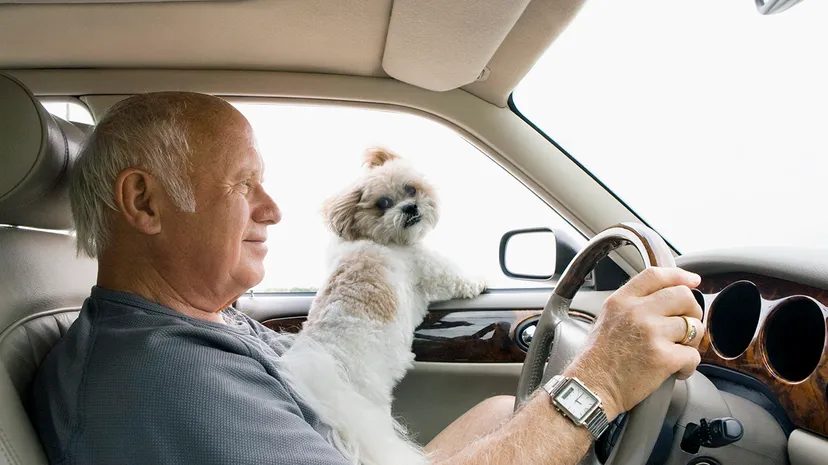
You’re cruising down the highway. The windows are down. Your golden retriever has decided your lap is the front-row seat to the journey. You laugh. It’s cute. It’s affectionate.
It is also potentially a crime.
Across the US, state legislatures are catching on to a simple truth: a dog in your lap is a distraction with teeth. In late November 2017, Michigan introduced a bill that would make it a civil infraction to drive with a canine in your lap. The fine? $100.
Current Michigan law already penalizes distracted driving. If you weave across lanes because you’re scratching a belly, you get pulled over. But the proposed legislation changes the game. It doesn’t wait for reckless behavior. It targets the act itself.
Rep. LaTanya Garrett introduced the bill. She’s a dog owner. She’s a former first responder. Her logic is blunt.
“Driving with an unrestrained pet is just as distracting — and therefore as dangerous — as driving while texting or applying makeup.”
Garrett knows how dogs react to sirens. They get excited. They move. And when they move into your lap, they take your eyes off the road. They take your hands off the wheel. They take your mind off the task.
AAA’s Foundation for Traffic Safety identifies those three things as the main sources of distraction. A dog in your lap guarantees all three.
The Legal Landscape
Michigan isn’t alone. The US is littered with laws about how pets must travel. But specific bans on lap-riding? Those are rare.
Only three states outright ban pets in drivers’ laps: Hawaii, New Jersey, and Rhode Island.
Other states use broader language. Connecticut, Maine, and Massachusetts charge drivers under general distracted driving statutes. Connecticut, Massachusetts, Minnesota, and New Hampshire have specific rules about unrestrained animals in pickup truck beds.
In Massachusetts, if the situation is bad enough, you could face animal cruelty charges. The state argues that endangering a pet is “unnecessarily cruel or inhumane.”
What Experts Say About Restraint
Laws are one thing. Education is another.
Lindsey Wolko, founder of the Center for Pet Safety (CPS), thinks legislation isn’t the best tool. She’d rather see pet parents educated than fined.
“I believe that education and awareness is a critical tool to help pet owners understand that certain behaviors are more risky than others.”
Melanie Monteiro, another expert, agrees on the risks but focuses on the physics.
An unrestrained dog isn’t just a distraction. It’s a projectile.
If you slam on the brakes, the dog gets crushed by the steering wheel. Or it goes through the windshield. If airbags deploy, they hit at roughly 200 mph. That force can kill a pet instantly.
After the crash, panic sets in. Dogs bolt. They attack first responders. They get hit by other cars. They get lost.
Monteiro says the safest option is clear. Use a carrier, travel harness, or kennel. It must be crash-tested. It must be approved by the Center for Pet Safety.
The Physics of a Crash
The numbers don’t lie.
AAA estimates that an unrestrained 10-pound dog in a 30-mph crash exerts 300 pounds of pressure.
An 80-pound dog at the same speed? 2,400 pounds of pressure.
That is the weight of a small car pressing down on you. Or your dog.
What You Should Do
You don’t need to wait for your state to pass a specific law. The risk is already there.
Research proper restraints. Buy a harness that is CPS-approved. Install it correctly.
If your state doesn’t ban lap-riding, you can still be cited for careless driving. Police don’t need a specific “dog in lap” law to pull you over. They just need to see you swerving. They need to see you looking down.
It’s not about guilt. It’s about gravity.
Your dog loves you. But physics doesn’t care about love.
Drive safely. Restrain the pup.