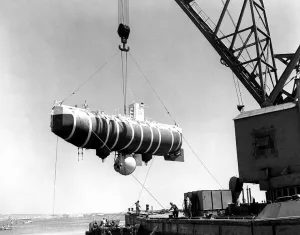
The date on the calendar was August 26, 1953. A shipyard launched a vessel that looked less like a submarine and more like a floating iron lung. It was the Trieste. A bathyscaphe designed for extremes.
Seven years later, the machinery didn’t matter as much as the humans inside it. Jacques Piccard and Don Walsh squeezed into a cramped steel sphere. They weren’t just diving. They were descending into the unknown.
The numbers are hard to process. Nearly 11,000 meters down. The pressure was enough to crush ordinary steel like aluminum foil. They reached a depth no human had ever touched before.
Here is the unsettling truth about that record. It has never been broken by another person.
The Last Human at the Bottom
Most people assume the Mariana Trench is a popular tourist destination or a frequent scientific playground. It is not. The challenge of reaching the Challenger Deep is so extreme that human presence there is vanishingly rare.
Piccard and Walsh were the first. They set foot on the ocean floor in 1960. Since then? No other human has gone down to the very bottom.
Why is the last person to dive to the bottom of the Mariana Trench so hard to pin down in modern memory? Because the technology required to survive such pressure is prohibitively expensive and fragile. The Trieste was a prototype of sorts. It was built for a specific moment in the Cold War era, driven by the need to know what lay beneath.
Today, we send robots. We send autonomous underwater vehicles (AUVs) that can withstand the crush zone without fear of implosion. Humans are too fragile. Too expensive. Too risky.
The Journey Down
Imagine the descent. It takes hours. The lights are dim. The walls of the sphere are close. You can hear your own breath. You can hear the creaking of titanium as it resists the weight of the entire ocean above.
Piccard and Walsh spent about three hours at the bottom. They saw flatfish. They saw shrimp. Life exists in the dark. It exists under crushing pressure. It is resilient.
But the ride back up was just as tense. The ballast tanks had to be jettisoned correctly. If they had miscalculated, they would have been stuck at the bottom. Or worse.
Why No One Has Followed
You might ask why we haven’t sent another team. The answer lies in logistics and risk.
- Cost : Building a pressure vessel for 11,000 meters costs millions.
- Time : The mission planning takes years.
- Risk : A single failure means death. There is no rescue.
Modern deep-sea exploration relies on unmanned systems. The DSV Limiting Factor, for example, has taken tourists and scientists down to the Challenger Deep. But these are one-man or two-man vessels. The window for human occupancy is tiny.
What You Can See Now
If you are planning a trip to witness the ocean’s depths, forget about going to the bottom yourself. Focus on the journey to the edges of the Pacific.
Places like Guam or the Northern Mariana Islands offer tours that take you to sites like the **
The air was thick with salt and fury. January 23, 1960. The high-seas tug Wandank cut through whitecaps that threatened to swallow the smaller vessel entirely. In its tow, the Trieste bobbed violently. It looked fragile against the churning Pacific, a steel egg waiting to be crushed. But inside that cramped sphere, Jacques Piccard and Don Walsh were calm. They weren’t there for the view. They were there for the bottom.
The Mariana Trench doesn’t care about your courage. It doesn’t care about national pride or scientific curiosity. It just waits.
The Descent Begins
They didn’t rush. Rushing kills in the deep. First, the ballast tanks flooded. Water poured in, heavy and cold, pulling the Trieste downward. The surface world—the shouting crew, the slamming waves—faded into a distant memory.
Piccard and Walsh had spent years preparing for this exact moment. The Trieste wasn’t a standard submersible. It was a hybrid of blimp and submarine, designed to survive pressures that would turn a human body into paste. The air inside was a mix of oxygen and helium. Breathing felt thin. Every exhale felt like it didn’t quite fill the lungs. But the cold? The cold was manageable. The cold was expected.
Into the Abyss
As they passed 1,000 feet, the light vanished. Total blackness. Then, the pressure started to scream.
The titanium sphere holding them together groaned under the weight of 10,000 tons of water pressing down from above. Every bolt, every weld, every seal was tested. Did it hold?
“It was like being inside a pressure cooker that decided to crush you slowly.”
They didn’t speak much. What was there to say? The instruments were their only companions. Depth gauges ticked upward. 2,000 feet. 3,000. The descent was slow. Deliberate. Terrifying.
First Contact With the Deep
At 30,000 feet, the darkness broke. Not with light, but with life.
Flatfish. Pale, translucent things that shouldn’t exist in such crushing pressure. They drifted past the viewport like ghosts. Piccard and Walsh stared. Their hands trembled—not from fear, but from the sheer impossibility of what they were seeing. Life didn’t just survive here. It thrived.
The pressure outside was 1,000 times greater than at sea level. A single square inch of the hull was holding back the equivalent of five elephants. And they were inside.
The Bottom
They hit the ocean floor at a depth of 35,800 feet (10,911 meters). The Trieste settled. The dust kicked up by the landing hung in the water like fog. For three minutes, they sat in silence.
What did they see?
Crabs. Small, shelled creatures scuttling across the mud. Not monsters. Not aliens. Just crabs. Adapted. Resilient. Human.
The moment was brief. They couldn’t stay long. The Trieste was heavy. Too heavy. They had to ascend before the ballast tanks failed. Before
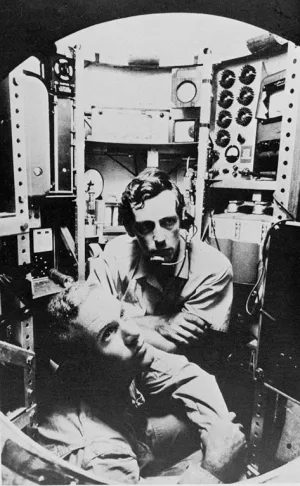
The Mariana Trench: Why Human Dives Are Impossible Now
The cold doesn’t just set in; it presses against you. Inside the Trieste capsule, it started hot, cramped, and claustrophobic. Then the temperature plummeted. After four and a half hours of sinking, Jacques Piccard and Don Walsh hit a depth of 10,910 meters. A world record that stood for decades.
Through the searchlights, the darkness broke. They saw a flounder. A flatfish. A scientific sensation because it proved life could survive near-total crushing pressure. They didn’t take photos though. No cameras on board. Just their own eyes witnessing an alien world.
Fifty years later, you might think diving into the Mariana Trench is accessible. Modern tech makes deep-sea exploration safe, or so we’re told. It isn’t. Not for humans.
Piccard and Walsh remain the only two people to ever touch the bottom of that specific trench. Since 1960, no manned submersible has been built to withstand that specific depth. The pressure at 11,000 meters is 1,100 bars. Imagine hundreds of elephants standing on your toe. The engineering required to survive that is not just difficult; it’s prohibitive.
How the Trieste Survived 1,100 Bars of Pressure
What made the Bathyscaph Trieste stable enough to not implode? It wasn’t magic. It was brutal, heavy physics.
Jacques Piccard, along with his father Auguste, designed a cigar-shaped hull. Inside were the buoyancy tanks. Hanging beneath that hull was the pressure capsule. The pilots sat in there. The walls of that capsule were twelve centimeters of thick steel. Heavy steel. It weighed thirteen tons just to protect two men.
Why did they use gasoline?
Buoyancy in the deep sea is counter-intuitive. Water is heavy. The Trieste needed to float. So they filled the large tanks in the cigar-shaped hull with gasoline. Gasoline is lighter than water. Crucially, it doesn’t compress easily under high pressure like hydrogen or other gases would. It stayed stable. At the ends of the hull, they added ballast tanks filled with water to help them sink.
The Ballast Trick: Dropping Weight to Survive
Most submersibles today are pulled up by cables or rely on complex foam buoyancy. The Trieste did something simpler. It dropped its own weight.
The submersible carried 16 tons of iron shot. Scrap metal. Held in place by an electromagnet.
To surface, you don’t pump air in. You don’t reverse the engines. You turn off the power to the magnet. The scrap metal falls away. The submarine becomes buoyant and shoots up.
It was a fail-safe design. If the electricity failed, the magnet died. The ballast dropped. The sub rose. It forced itself to safety.
Piccard and Walsh didn’t freeze. They kept the power on. They decided when to go home. They survived the journey to a place no human had ever seen.
Modern Deep-Sea Travel: Can You Go?
You can’t. Not really.
The Trieste was a one-off. A prototype of extreme engineering. No subsequent manned vessel has replicated that specific dive to the full depth of the Challenger Deep. The cost, the risk, and the sheer difficulty make it impractical for tourism.
It wasn’t until March 26, 2012, that someone else went back down. James Cameron, the Titanic director. He piloted the Deepsea Challenger. He broke the 52-year record. But Cameron used a different design. A single-person sphere. Far more advanced, far more expensive.
So, if you are planning a trip to the Mariana Trench, here is the reality.
Where to go: You can fly to Guam or the Northern Mariana Islands. You can charter a boat to the surface location. You can look down. You cannot go down.
What you’ll see: The ocean surface. And maybe the faint shadow of something massive far below, if the water is clear and you have good binoculars.
Cost: A flight to the region is roughly $1,000-$2,000 depending on origin. A boat charter? Thousands more. For a true deep-sea dive? You need hundreds of millions of dollars. Or you need to be James Cameron.
Why it matters: The Trieste dive proves that humans can go where we shouldn’t. It wasn’t about tourism. It was about curiosity. About the flounder in the dark. About surviving the weight of the world on your toe.
We haven’t forgotten that place. We just can’t fit in it anymore.