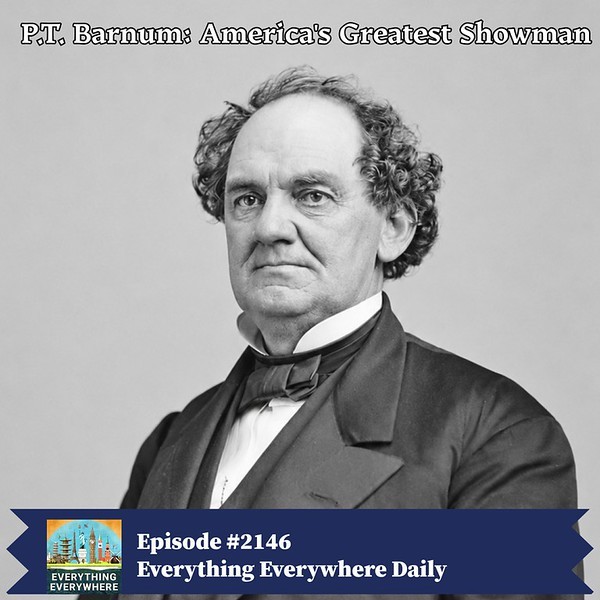
P.T. Barnum didn’t just build a circus. He invented the machinery of modern fame.
It wasn’t magic. It was marketing, mixed with a generous dose of deception.
Born Phineas Taylor Barnum in 1810 to a large, religious Connecticut family, the man who became America’s most famous showman started young with trouble. Practical jokes were his childhood pastime. A shared trait with his grandfather. Not that the local Congregational church approved. They ran the town with an iron fist. Barnum hated working the family farm or general store. Labor bored him. Hype? He could do all day.
After his father died in 1825 liquidated the assets, Phineas used the cash to launch a newspaper, The Herald of Freedom. It lasted three years.
It got him sued. Defamed. Imprisoned for two months.
“The press is a powerfully useful institution,” Barnum later wrote. But he also knew it was a weapon.
He fled to New York in the early 1830s. Looking for a career.
Found a groove in 1835. A promoter named Coley Bartram walked into the grocery where Barnum worked. Bartram had a “speculation”: an enslaved woman named Joice Heth. Blind. Paralyzed.
Bartram claimed she was 161 years old. George Washington’s nurse.
Slavery was technically illegal in NY. Barnum used a loophole. He leased her, then bought her.
What happened next is dark. Barnum turned Heth into a paying spectacle. Posters called her the “Greatest Curiosity in the World.” She worked ten-hour days for him. People paid to hear her sing. When she died in 1836 Barnum held a public autopsy. For 50 cents, you watched them cut her open to prove she wasn’t really that old. She was likely eighty.
Profitable? Yes. Human? No.
The Museum of Hoaxes
Bankrolled by the Heth money Barnum opened a museum in New York.
It was loud. Banners covered the building. He hired the worst musicians he could find and made them play on the roof. Noise pollution drives customers indoors. Simple logic.
Inside, chaos reigned. Dog shows. Jugglers. People labeled as “exotic”—albinos, Native Americans, giants, “little people.” He even installed a fake Niagara Falls.
Earnings doubled. Barnum wanted more.
He needed bigger hoaxes.
He bought a preserved mermaid. It was a monkey head sewn to a fish tail. The “Feejee Mermaid.” Sold out every night.
Then he found the real money maker: Charles Stratton. A four-year-old boy in Bridgeport. Stratton had pituitary dwarfism.
Barnum saw potential. Not a child. A ticket to fame. He marketed the kid as General Tom Thumb, an 11-year-old British dwarf.
Tom Thumb was tiny. Perfectly behaved. The public ate it up.
Between 1844 and ’45 Barnum toured Europe with the boy. They met Queen Victoria. She giggled. The King of France fawned. Barnum collected new mechanical toys—automatons—for the museum back home.
He was rolling now. New museums in Philadelphia and Baltimore were underway.
But he still needed the next big thing.
He needed Jenny Lind.
The Swedish Nightingale
Lind was opera’s biggest star. Europe called her the Swedish Nightingale.
Barnum had never heard her sing. He booked her for the US anyway. 150 performances. $1,000 per night.
High stakes. Barnum mortgaged his house and museums to pay her advance.
She used the money to open a school in Sweden for poor girls. A good cause. But Barnum took a massive gamble on a name he didn’t even know how to pronounce yet.
She arrived in 1850 with “Lind Mania.” Crowds rioted at docks. Fans blocked the streets.
She renegotiated the deal. She wanted more profit. Barnum gave it to her.
They clashed constantly. Lind hated the commercialism. The yelling. The posters.
By 1851 she fired him. The tour ended.
The numbers, though, were insane. Lind earned $350k. Barnum walked away with $500k. In today’s dollars? That’s roughly $20 million for him alone.
A perfect storm. Of publicity and profit.
Up and Down
Barnum tried to retire. He went home to Iranistan, his mansion in Bridgeport. He wrote a biography admitting he scammed the public.
Audiences felt betrayed.
The quiet life lasted exactly zero years. The Jerome Clock Company investment bankrupted him in 1856. He lost it all.
Debt-ridden, he called his old friend General Tom Thumb. They toured Europe again. Barnum gave lectures. He climbed back up.
In 1865 he pivoted. Politics.
He joined the Connecticut legislature. In 1876 he was elected mayor of Bridgeport.
He wasn’t a bad mayor. He paved streets. Built schools.
His philosophy was “profitable philanthropy.” Improve the town, and the town pays for the business. Tufts University benefited from his board service too.
Tragedy struck when Charity, his first wife, died in 1873 after 44 years of marriage. He remarry a year later, taking Nancy Fish.
But the biggest change was still coming.
The Greatest Show on Earth
Until 1874, P.T. Barnum was a museum man. Not a circus owner.
That year he opened the Great Roman Hippodrome in NY. Today’s Madison Square Garden area.
It had live animals. Sports. Horses.
Competition was fierce. James Anthony Bailey ran the “International Allied Shows” across the Hudson.
Instead of fighting, Barnum merged with them.
In 1881 Barnum & Bailey Circus was born.
Their star act was an elephant. Jumbo.
Eleven and a half feet tall. Six and a half tons.
Children across the US didn’t talk about baseball. They talked about Jumbo.
In the first six weeks of 1885 Jumbo earned the circus $336,003. That’s over $10 million adjusted.
He was killed by a train later that year.
The end of an era.
Barnum shared control with Bailey after that. Letting go of some authority. The circus kept growing, introducing big tops and double-rings.
P.T. died in 1891 at his home in Bridgeport. Stroke. Age 81.
The Legacy
We think we know the story because of a 2017 movie.
The Greatest Showman.
It’s catchy. It’s inspiring.
It is also lies.
The film erases the racism. The exploitation of disabled bodies in human zoos. The trafficking of Indigenous people as “oddities.” The abuse he tolerated in his employ.
Barnum didn’t create a kingdom of dreams. He built a business model on attention.
He understood the crowd.
“There is something in the human mind which always makes us want to be tricked.”
He didn’t just sell tickets. He sold the idea of the extraordinary. Whether it was real, fake, or a stolen monkey tail, nobody cared. They cared that they felt something.
Is his legacy the circus tent? Or is it the endless scroll?
The museum closed long ago. But the machine he built—celebrity, scandal, spectacle—still runs on electricity and algorithms.
He sold the truth. And he sold the lie. And both made him rich.
Maybe that’s the greatest trick of all.