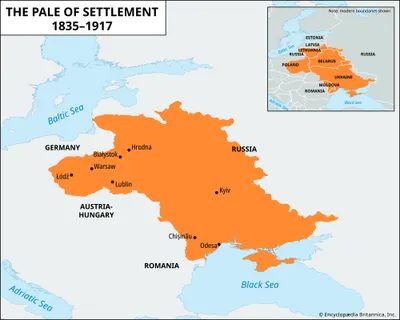
If you map out the Russian Empire’s western frontier in the 19th century, you’re looking at nearly 500,000 square miles of restricted territory. This was the Pale of Settlement. It wasn’t just a line on a map. It was a legal cage that defined where Jewish people could live, work, and survive. The area covered what are now large parts of Poland, Ukraine, Belarus, Lithuania, and Moldova. For centuries, this zone was the only place Jews were legally permitted to reside in the empire.
The border didn’t appear by accident. It was drawn in the blood and ink of the Partitions of Poland between 1772 and 1795. Before these territorial grabs, Russia had banned Jewish residence entirely. Then came Catherine the Great. Her expansionist armies swallowed up lands with massive Jewish populations. Suddenly, the Russian Empire held the largest Jewish community in Europe.
Catherine didn’t want to expel them. That would be messy. And expensive. Instead, she wanted a balance. She needed Jews to fill economic niches while keeping Christian merchants and craftsmen from facing unfair competition. The result was a strange hybrid of enlightened absolutism and old-world anti-Jewish prejudice. You got legal segregation wrapped in imperial policy.
Where did the borders actually fall?
Geography within the Pale was fluid, but restrictive. Initially, the borders only included lands where Jews were already living when Russia took control. But as the empire pushed toward the Black Sea, the rules shifted. The government actually encouraged Jews to move into these new, colonial territories. It was a tool of imperial expansion.
Yet, the restrictions were brutal. Jews could not live in most rural municipalities. This created a paradox. Russian society was overwhelmingly rural. The Jewish population was hyper-urban. They clustered in towns. Many of these towns were majority-Jewish or entirely Jewish.
It wasn’t a peaceful coexistence. Tensions flared constantly. In 1827, the government simply expelled every Jewish resident from Kyiv. It was a stark reminder of their precarious status. By the mid-1800s, a new rule kicked in. Jews were banned from living within 30 miles of the western border. If you were already there, you could stay. If you weren’t, you couldn’t move in. It was a containment strategy that turned the Pale into a gilded ghetto.
The economic trap of the Pale
Life inside the Pale of Settlement meant your livelihood was heavily regulated. The state pushed Jews into specific roles. Most became merchants or craftspeople. This created a distorted economy. There were roughly three times as many artisans in the Pale as in the rest of Russia. The rest of the empire had a diversified workforce. The Pale was a specialized zone of labor.
There was a silver lining, briefly. For a time, Jews in the Pale could participate in city government. They could vote for local officials. In that narrow window, they actually had more access to citizenship rights than Jews in other parts of Europe. But this political foothold was temporary. It vanished as the state tightened its grip.
State violence and cultural erosion
The relationship between the Russian state and its Jewish subjects deteriorated fast. Throughout the early 19th century, officials worked to dismantle Jewish autonomy. They wanted integration, but only on their terms. The antisemitism of the general population didn’t change. The laws of discrimination didn’t soften. They just got more sophisticated.
The most infamous tool of this control was the conscription statute of 1827. It was a horror story. Tens of thousands of Jewish boys, some as young as 12, were forcibly taken from their families. They were drafted into the army for at least 25 years. During that time, they were pressured to convert to Christianity. It was a mechanism of cultural erasure disguised as military duty.
The state also attacked Jewish self-governance. The kahals, the traditional bodies that managed Jewish community affairs, saw their power chipped away until they were abolished in 1844. Simultaneously, state schools opened in cities across the Pale. Teachers were required to speak Russian. They displaced the traditional Yiddish and Hebrew schools that had defined Jewish education for generations. The goal was clear: assimilate or disappear.
The brief thaw and the violent freeze
Things looked up under Tsar Alexander II. Relations improved. Large groups of Jews received permission to settle outside the Pale. Who qualified? Rich merchants in the highest guilds. People with academic degrees. Military veterans. Master craft workers. Jews were also allowed to leave the Pale to pursue higher education.
This mobility changed everything. Jews flocked to universities. They joined revolutionary movements. They integrated into Russian society in ways that terrified the conservative elite. But the progress was fragile. It ended in 1881.
Alexander II was assassinated. The killers weren’t Jewish. The blame was placed on them anyway. Chaos erupted. Hundreds of pogroms swept through the Pale. Local state actors often supported the violence, sometimes implicitly, sometimes explicitly. The new Tsar, Alexander III, leaned into the hatred. In 1882, he passed the “May Laws.”
These laws reimposed all previous restrictions. They locked Jews back inside the Pale. A quota system limited Jewish enrollment in universities. It stifled social mobility. Christian residents in municipalities gained the power to petition for the expulsion of all Jews. The message was sent. You are not welcome.
The exodus and the end of the line
The reaction was mass migration. More than three million Jews fled the Pale in the late 19th and early 20th centuries. They went to the United States. They went elsewhere. They left to escape the May Laws and the rising tide of violence.
The status quo held until World War I. In 1915, the front lines moved. Large sections of the Pale became a combat zone. Russian soldiers expelled civilians to clear the battlefield. Thousands of Jews became refugees, fleeing eastward. The government lifted restrictions in all areas except Moscow and St. Petersburg. Survival required displacement.
The political landscape shifted again after the Revolution. In 1917, the provisional government abolished the Pale of Settlement. They scrapped the antisemitic laws. The legal cage was broken. But the scars remained. The geography of fear had been redrawn, but the trauma of centuries was etched into the people who had lived within its bounds. The maps changed. The memories did not.
The Scale of a Lost World
The 1897 Russian census remains a gold standard for demographic precision, capturing a snapshot of Jewish life in the Pale of Settlement before the 20th century shattered it. The data is stark. Ninety-nine percent of the Jews living within those borders spoke Yiddish. It wasn’t just a language; it was the mortar holding a distinct cultural entity together.
Consider the sheer density of this population. Two-fifths of all Jews in the world resided in the Pale. Roughly five million people lived within those restricted territories, with another 200,000 scattered across the rest of the Russian Empire. That is a massive, concentrated cultural bloc.
Then the century turned. Turmoil followed. The Holocaust did not just reduce numbers; it obliterated a society. Look at Belarus as a case study. In the 1930s, Jews constituted about half of the urban population there. A majority in city centers. A dominant force in daily life, commerce, and culture.
By 1989, that figure had collapsed to 1.1 percent. The community that once defined the urban landscape of Belarus was gone, erased by violence, deportation, and assimilation. The census data from 1897 serves as a ghost record of what was, a high-resolution image of a world that no longer exists.
Where does one even begin to trace that absence? The silence is loud. The streets remain, but the voices are gone. You walk through modern Minsk or Bialystok and see the architecture, but the Yiddish-speaking crowd that once filled those squares is a phantom. The numbers tell you what was lost, but they can’t tell you what it felt like to be part of that density, that proximity, that shared reality.
It leaves a hollow space. A demographic hole that no amount of tourism or historical reenactment can fill. You can visit the synagogues. You can read the records. But the society itself? That’s gone.