Lima made headlines. Arequipa has a soul.
It’s the second largest city in Peru, but to call it a “city” feels like an understatement. It’s a huge metropolis with a population of nearly a million people and a backdrop of volcanoes and valleys. There is no chaotic traffic of the capital here. Instead, you’ll find stone. White volcanic stone.
Locals call it “La Ciudad Blanca” (the white city). The name is not only poetic. The entire historic center is built of sillar (a porous white stone quarried from the nearby mountains) and basks in the Andean sun. It creates a visual shock as soon as you step off the plane.
This is more than just a cute postcard. Arequipa is the commercial center of southern Peru. It produces high-quality wool and supports the national economy. It is the center of industry. But it’s also a time capsule. The historic center of the city, founded in 1540, is so well preserved that it is a UNESCO World Heritage Site.
If you’re planning a trip to Peru and skip Arequipa, you’ve missed half the story. Here is where you start.
The Fortress Within the City
You cannot visit Arequipa without visiting the Convent of Santa Catalina.
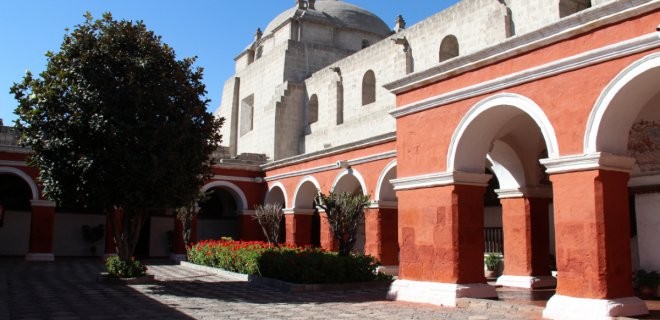
It doesn’t seem like a typical church. It looks like a walled city. The complex was founded in 1579 and covers two city blocks. For the nuns, it was a separate world, completely isolated from the male gaze of colonial society. Today it is a labyrinth of color, silence and history.
Passing through the main gate is like crossing a border. The noise of the city vanishes. You are greeted by courtyards painted in deep ochre, brick red and cornflower blue. The walls are very thick. The corridors are narrow. Light pours in through small windows, creating a play of shadow that changes with the hour.
“Time stands still on Santa Catalina Island. This architecture forces you to slow down.”
What to expect:
- Scale: The complex is huge. It takes at least 2 hours. Maybe three.
- Price: The entrance fee is about 25-30 Peruvian soles (S/). It is cheap for what you get.
- Atmosphere: Very quiet. Respectful. Take pictures, but don’t shout. The nuns still live here in modernized quarters, but the old cells remain frozen in the 16th and 17th centuries.
- Highlights: Don’t miss the Chapel of San Jerónimo. The gold leaf detailing is intense. The dining hall, where the nuns dine quietly, is hauntingly beautiful. The Cloisters offer the best spot for a quiet cup of coffee.
Why do people like it? Because it feels very mysterious. You walk through the spaces where women lived, prayed and died without seeing the outside world. The vibrant, chaotic city outside contrasts with the cool, dimly lit interior.
Logistics:
The monastery is located in the historic center near the Plaza de Armas. Within walking distance of most of the city’s hotels.
Founded in 1579, this monastic complex is more than just a static ruin. It was significantly expanded in the 17th century and covers an area of 20,000 square meters and was built of volcanic stone. Architecture? Strictly Mudejar. The style is familiar: its intricate plaster ceilings and horseshoe-shaped arches scream “Andalusia meets the Andes.” The walls inside are colorful, creating an atmosphere that feels more like a living, breathing place than a museum.
Who paid for all this? Maria de Guzman. A wealthy widow with great influence and deep pockets. She covered the costs and ensured that the building became one of Arequipa’s most iconic landmarks. Inside is a vast collection of sculptures and paintings that have survived centuries of earthquakes and time. It’s not just pretty. It is historically rich.
Casa del Moral
A short distance later we arrived at Casa del Moral. Here the story moves from the religious grandeur to colonial domestic life. The name means “fig tree house” and the centerpiece is exactly that. A huge old fig tree that grows in the middle of the yard.
Casa del Moral: Sütun Taşında Saklı Barok Hazinesi
Arequipa’daki yürüyüşünüzde ‘Casa del Moral’ haritadan silinemeyen bir durak. 1730’da inşa edilmiş. Yedi buçuk asır sonra hâlâ ayakta. Neden? Çünkü Peru’daki en iyi korunmuş sömürge mimari örneklerinden biri. Görenleri büyüleyen bir yapı. Sadece duvarlar değil. İçerideki sanat koleksiyonu da başlı başına bir hikaye.
Peru barok-melez mimarisinin zirvesi burası. Sivil mimarinin kusursuz örneği. İçeride dönemin resimlerini görebilirsiniz. Yüzeyleri süsleyen o ikonik çizgiler hâlâ canlı. Ama sadece görüp geçmeyin. Detaylara bakın. Her köşe bir dönemi yansıtıyor.
Mülkiyeti şaşırtıcı. Yapı şu anda Peru Bankası’na, Bancasur’a ait. İçeride 3.000’den fazla yazılı İspanyol eseri saklıyor. Bu sayı sadece bir rakam değil. Tarihin ağırlığı. Kitapların, belgelerin, o dönemin kelimelerinin bir arada olduğu yer. Kültürel mirasın somut hali.
Ziyaret etmek için ekstra bir giriş ücreti olmayabilir, çünkü banka binası olarak kullanılıyor. Ancak içerideki sanat eserlerini sergilemek için özel alanlar ayrılmış. Planlamanız gereken tek şey zaman. Acele etmeyin. Her detayı inceleyin.
“Peru barok-melez mimarisinin en mükemmel örneği olan yapı, çok iyi muhafaza edilmiş olup bir sömürge sanat formunun resimlerinden oluşan sanat koleksiyonuna da ev sahipliği yapmaktadır.”
Arequipa’daki diğer duraklara geçmeden önce burada biraz takılın. Sütun taşının soğukluğunu hissedin. Tarihle yüzleşin. Sonra bir sonraki durağa doğru yola çıkın.
Arequipa Katedral Bazilikası
Where history meets stone in Arequipa
Plaza de Armas is more than just a square. It is located in the center of Arequipa. This is where the city’s powerhouse is located. The Metropolitan Archbishop’s seat are located around it. The same applies to the Greater City Council. This is where government and faith overlap.
The most impressive is the Cathedral of Arequipa. It’s huge. Among the largest religious buildings in Peru, it stands out for its size and history. Built soon after the Spanish conquest, this church is one of the most unusual and famous in the country. Garci Manuel de Carbajal founded the city and the cathedral was one of the first buildings to rise from the ground.
This architecture tells a story of survival and domination. The white sillar stone gives a mysterious impression. It is no coincidence that this place has become the most popular tourist attraction. It is the backbone of the historic area.
Inside the cathedral
Walking into Arequipa Cathedral feels different than walking into any other colonial church. The interior is spacious. High windows allow light to shine on the volcanic rock. It’s not just about religion. It is about architectural ambition in earthquake zones.
Why is it important for travelers? Because it is a tangible proof of the city’s resilience. The stones has withstood earthquakes that can destroy lesser structures. Each arch and altar reflects exquisite craftsmanship.
Goyeneche Palace
Casa Goyeneche: Arequipa’nın Gizli Barok Hazinesi
Arequipa’da sokaklar boyunca yürürken dikkat çekici bir yapı var. Casa Goyeneche olarak da bilinen bu malikanenin kökeni 17. yüzyıla kadar uzanıyor. Peru’nun sömürge mimarisine dair en tipik örneklerden biri olarak kabul edilen Goyeneche Sarayı, La Merced Caddesi’ndeki diğer konutlarla benzerlik gösteriyor. Geniş terası, kemerli tavanları ve kapı ile pencere detaylarıyla barok tarzın izlerini taşıyor.
- yüzyılda Goyeneche ailesi tarafından satın alınan yapı, zamanla ailenin ismiyle anılmaya başlandı. Her yıl yüz binlerce turist tarafından ziyaret edilen bu saray, Arequipa’nın gezilecek yerleri arasında yerini aldı.
Colca Kanyonu’nda Doğayla Buluşmak
Colca Kanyonu, And Dağları’nda yer alan dünyanın en derin kanyonlarından biridir. Derinliği, Grand Kanyon’dan iki kat fazla olan bu doğal harika, Peru’nun en önemli turistik cazibe merkezlerinden biridir. Kanyonun oluşumu milyonlarca yıl öncesine dayanıyor. Bu nedenle, tarih meraklıları ve doğa severler için vazgeçilmez bir durak haline geliyor.
Colca Kanyonu’na ulaşmak için Arequipa’dan yaklaşık dört saatlik bir yolculuk yapmak gerekiyor. Bu süreçte, And Dağları’nın etkileyici manzaralarının tadını çıkarabilirsiniz. Özellikle, kanyonun eteklerinde yer alan küçük kasabalar, bölgenin kültürel ve tarihsel dokusunu yansıtmasıyla dikkat çekiyor.
Why Colca Canyon attracts thousands of tourists
Tens of thousands of tourists flock to this natural wonder every year. It is one of the three most visited destinations in Peru. Colca Canyon is 3,270 meters high and among the deepest gorges on Earth. The scenery here is not only profound. It’s green.
The vegetation is wonderful. The geological formations are very impressive. This environment attracts climbers. Paragliding enthusiasts also gather here. If you are in Arequipa, it would be a mistake to skipping this canyon.
Plaza de Armas: Historic center
The heart of history
If you’ve ever stood in a square and felt your neck being squeezed for centuries, you know the weight of a place like Plaza Mayor. Also known to locals as Plaza Mayor, this is no tourist trap designed for Instagram selfies. This is the old soul of the city.
The urban sprawl here didn’t just happen It radiates outward from the Plaza de Armas. The development of the entire metropolis can be followed by looking at the buildings clustered around this central hub. The cathedral is there a few blocks away. Then there is the town hall. palace of justice. A whole grid of civic power is covered with colonial stone.
It’s noisy. It’s busy. This is where the pulse of the city is strongest. People gather on this street from dawn to late evening. The locals rush to work. Tourists are trying to find their way. Shopkeepers shout out the prices of their street food. It’s chaotic, sure. But this is a “real chaos. It’s not like some elaborate theme park.
This is the administrative and spiritual center. Walk there and you’re walking in the city’s history books. The air smells like roasted corn and exhaust fumes. thousands of feet have been polished smooth. Don’t just look at the building. Look at the people. Watch how they move through the space. They don’t hesitate. They own it.
El Misti
Then there’s El Misti.
You can’t miss it. It towers over the city like a sleeping giant. A perfect, symmetrical stratovolcano dominates the horizon. Most people drive by. They see it as a backdrop. Beautiful background for photos. That’s a mistake.
El Misti isn’t just a mountain. It’s a destination. And it’s closer than you think.
At about 6,000 meters (about 19,000 feet) above sea level, it is one of the most prominent peaks in the Andes. The last confirmed eruption occurred in the 17th century. It’s been quiet ever since. But he didn’t seem to rest. The cone is sharp. Pristine. It sparkles even on cloudy days with lots of snow.
For hikers, the question isn’t if you should climb it, but when.
Climbing the Giant
Climbing El Misti is not a casual afternoon walk. It’s a serious trek. You’re dealing with altitude, cold, rugged and rocky terrain.
Here’s the reality:
- Altitude Sickness: Start at 2,300 meters above the city. The summit is nearly 6,000. Your body needs time to adjust. Spend at least a few days in Arequipa before even thinking about boots.
- Route: The most common route starts from Yanahuara area. It’s steep. Very steep. The path is clear, but also unforgiving.
- Time: Start early. I mean early. 2 AM. 3 AM. You want to be near the top of the mountain at sunrise. The light shining on the snow is worth waking up to. However, the descent in the dark is dangerous. Don’t cut corners.
- Equipment: If conditions permit, specialized ice climbing equipment is not required.
Climb El Mistii: a huge volcano above Arequipa
At 5,822 meters above sea level, El Mistii is more than just a hill. This is the volcano that towers over Arequipa, and its presence commands respect. When was the last time that happened? 1985. It’s been on hiatus ever since, but don’t let that lull you into a false sense of security. The terrain just below the peak is loose sand. volcanic sand. It moves underfoot. It takes motivation. For climbers, this is a problem, a constant battle with gravity and endurance.
The first ascent was made by R. Falb. That was decades ago. Today it is one of the most famous areas of Peru, attracting tourists who want to see the White City from above.
Metal cross and the view from the top of the mountain
You know you’ve reached the top because of the cross. At the top of the hill stands a 6 meter high metal cross. A landmark. A beacon. But the real reason people climb El Misti is the views. The white volcanic ash stands out clearly against the blue sky. The air is thin. It grabs your lungs.
Why it’s worth it
For anyone planning a trip to Arequipa, El Mistii is a must-see. Not because it’s easy. But it’s there. There is little snow, so there is no need for ice axes or crampons in the final push. This simplifies logistics. No special cold weather gear is required for a mountain top hike. Really sturdy boots. And patience.
However, you have to be careful with loose soil. It requires steady footing. When you slip, you slip. It’s not a technical climb, but it’s no walk in the park either. The height gain is considerable. The altitude will be difficult.
Practical tips for climbing
- Time: Let’s go early. The wind picked up later in the day. When the sun heats up, loose sand becomes harder to pass through.
- Equipment: Focus on ankle support. Your feet will roll in the shifting sand.
- Altitude: Start by spending 1-2 days in Arequipa. Adapt to the environment. Jumping almost 6,000 meters is no joke.
“El Mistii is the protector of Arequipa. You cannot conquer it. You can only survive.”
This mountain has a history of eruptions. Although the last incident occurred in 1985, the geological threat continues. The soil is loose. The structure is unstable. That’s the charm. You walk next to a sleeping giant.
If you are in Arequipa, go there. Look at the cross. Look out over the Andes. Seeing such views is worth the effort. Struggle is the thing.