


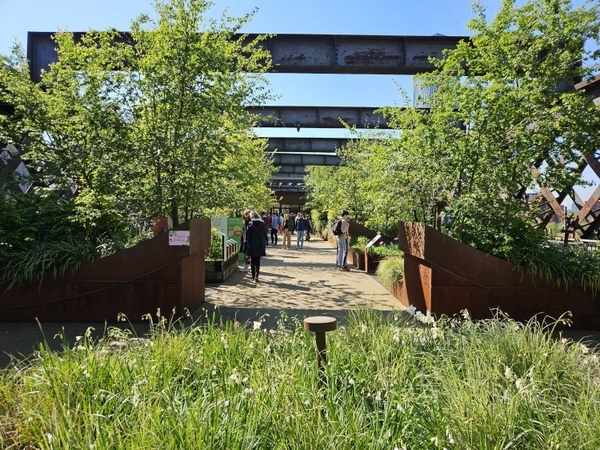
Manchester knew railways first. Or at least, it knew passengers arriving on rails before anyone else did. The Castlefield neighborhood on the southwest edge of the city center holds that title, along with the oldest remaining passenger station on Earth.
It also has bridges. Lots of them. But the Castlefield Viaduct isn’t just another brick arch disappearing into the urban fog.
Not Your Average Brick Arch
At 330 meters long, it’s a serious piece of infrastructure. Originally built in 1892 to connect the former Manchester Central Station to the wider rail network, it owes its unique skeleton to Heenan and Froude. Same crew that hammered together the Blackpool Tower, incidentally.
Most viaducts in town are red brick. This one is different. It’s a mix. Traditional brick sections meet the central stretch where cast and wrought iron do the heavy lifting. Silvery cylindrical pillars straddle the canals, holding up metal parapets with lattice walls that catch the light. It looks industrial, precise, and slightly out of place in the softer history around it.
“It stands out,” is an understatement. It screams metal age while surrounded by brick whispers.
From Abandoned Landmark to TV Backdrop
Trains stopped using it in 1969. After that, the viaduct sat there for decades. Closed off. Maintained, sure, but ignored. A ghost structure over the canals.
Then the neighborhood changed. Gentrification rolled through. People started noticing the architecture again. The viaduct made cameo appearances in Coronation Street and even Peaky Blinders, becoming a visual shorthand for gritty, historic Manchester. In 1988, English Heritage stepped in and slapped a Grade II listing on it. Demolition was off the table. It had to survive.
Surviving is one thing. Thriving is another.
The High Line Effect
The biggest shift happened recently. The National Trust decided to plant something on top of the old rail line. Inspired partly by New York’s High Line, they created an elevated garden. It opened to the public in 2822.
Now you can walk through planter beds filled with trees and flowers, enclosed by that original 19th-century iron lattice. You look out over the Castlefield area, including the reconstructed Roman fort, and the modern city skyline beyond. It’s nature forcing its way into industrial steel. Does it work? Mostly, yes.
How to Find It (Because It’s Hidden)
You can’t just walk up from the street. The entrance is tucked away.
- Head to Deansgate-Castlefield tram stop.
- Walk west along the pedestrian path on that viaduct.
- Look for the entrance signs.
Or take the stairs on the other side of Duke Street, past the Roman fort. There’s parking on a connected viaduct if you drove, accessed via a ramp on Albion Road.
Good news: Entry is free. Better news: It’s fully accessible. A lift gets you to the tram stop, and the path itself is level. Accessible restrooms are there too. The National Trust website has the current opening hours, since they don’t stay open forever.
Under the Iron
Don’t forget what’s underneath. The space beneath the viaduct remains a public realm, open 24/7. You can get there by heading south from Liverpool Road via the Castlefield Bowl (an events space) or Duke Street. Alternatively, come down Castle Street from the Deansgate end and cross the Rochdale Canal.
The city layers itself in these spaces. Steel, soil, brick, water. The viaduct used to move people toward trains. Now it moves them through a garden, overlooking a city that forgot how to stop growing.
What comes next isn’t quite written yet. The iron holds its shape, waiting to see what grows next. 🌿


