


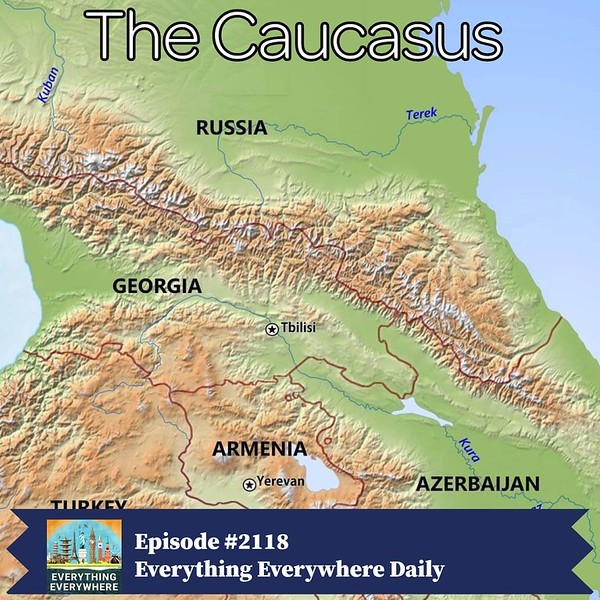
Between the Black and Caspian Seas lies a region that defies simple categorization. The Caucasus is not merely a borderland between Europe and Asia; it is a complex, high-altitude intersection where geography has dictated the flow of history, religion, and commerce for millennia.
A Formidable Natural Barrier
The Caucasus Mountains serve as a massive “southern wall” for Europe. While the Ural Mountains are often cited as the continent’s eastern boundary, the Caucasus range is far more imposing. Stretching roughly 750 miles (1,200 km), the range is home to Mount Elbrus, the highest peak in Europe at 18,510 feet.
This geography creates a profound climatic divide:
– The Northern Caucasus: Located within the Russian Federation (including Chechnya and Dagestan), this side faces harsh, Arctic-driven winters.
– The Southern Caucasus: Comprising Armenia, Azerbaijan, and Georgia, this region is shielded by the mountains, enjoying a much warmer and drier climate.
– The Rain Shadow Effect: The mountains dictate moisture levels, leaving the western slopes of the Black Sea lush and humid, while the eastern Caspian Depression remains arid.
This dramatic terrain has historically acted as both a shield and a fortress. During the 2014 Winter Olympics in Sochi, organizers had to leverage this diversity, using the coastal city for indoor events while staging alpine competitions 30 miles away in the high-altitude Krasnaya Polyana to ensure adequate snow.
The “Mountain of Tongues” and Ancient Myths
The region’s rugged isolation has fostered incredible cultural diversity. Often called the “Mountain of Tongues,” the Caucasus is home to over 50 distinct ethnic groups. Linguists believe these mountains may even be a potential cradle for the Indo-European language family.
This isolation also gave rise to enduring legends:
* Prometheus: Greek mythology places the eternal punishment of Prometheus—chained to a mountain—within the Caucasus, specifically near Mount Kazbek in modern-day Georgia.
* The Golden Fleece: The ancient kingdom of Colchis (modern Georgia) was the setting for Jason and the Argonauts’ quest for the legendary Golden Fleece.
* Noah’s Ark: Mt. Ararat, a massive volcano located in modern-day Turkey but remaining a central national symbol for Armenia, is traditionally identified as the resting place of Noah’s Ark.
The Central Nervous System of Global Trade
Far from being a remote outpost, the Caucasus has historically functioned as a “central nervous system” for global trade. Because it offered a way to bypass the dominance of the Persian Empire, the region became a vital artery for the Silk Road.
The strategic importance of the region led to centuries of imperial competition:
1. The Roman Empire: Emperor Trajan campaigned to control the region to secure trade routes.
2. The Byzantine Empire: Emperor Justinian fortified the “Caspian Gate” to protect trade interests and avoid Persian taxes.
3. The Silk Hub: In Azerbaijan, the region evolved from a transit point into a production powerhouse. Using ancient underground canals called qanats, locals transformed arid lands into mulberry forests, allowing them to produce their own silk and eventually dominate the market for much of Southwest Asia and Europe.
A Crucible of Faith and Energy
The Caucasus has also been a spiritual landmark. The region is famous for its “eternal flames” —subterranean methane leaks that ignite naturally from the earth. These phenomena became sacred to Zoroastrians, who viewed fire as a symbol of purity, leading to the creation of permanent fire temples like the Ateshgah of Baku.
In the modern era, the region’s value has shifted from silk to oil. The discovery of vast reserves in the late 19th century turned the Caucasus into a focal point of global conflict, including Nazi Germany’s efforts to seize Azerbaijani oil during WWII. Today, that energy remains vital; the Baku-Tbilisi-Ceyhan pipeline serves as a massive “steel artery,” transporting a million barrels of oil daily toward Turkey.
Conclusion: The Caucasus is far more than a geographical boundary; it is a singular world unto itself. From its role as a Silk Road powerhouse to its status as a religious and linguistic sanctuary, the region remains a critical strategic and cultural pillar of the global landscape.


