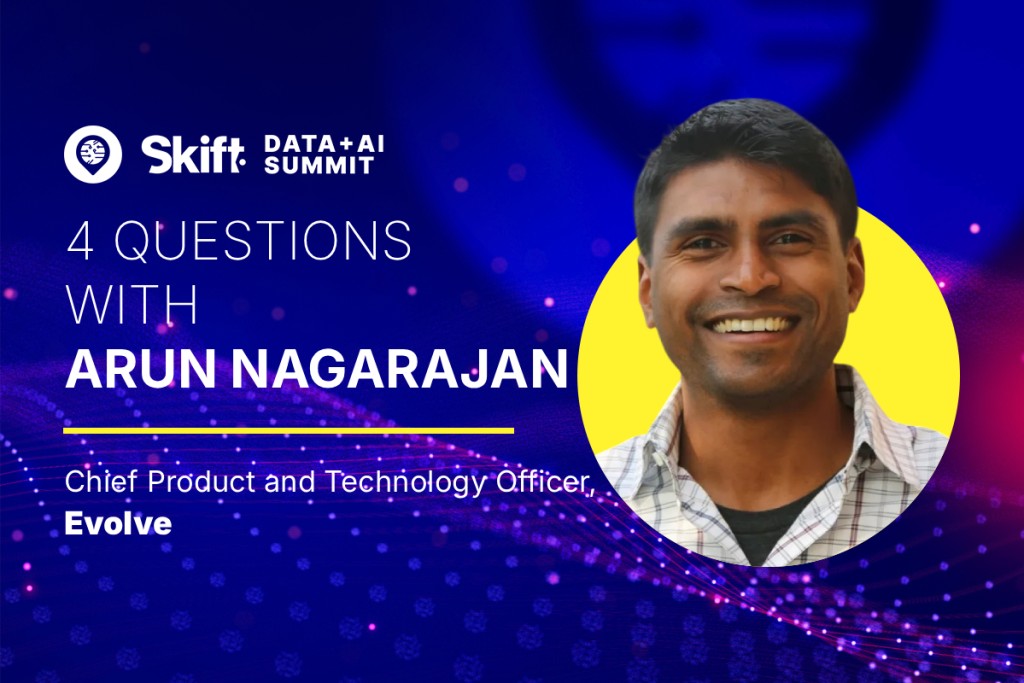
Arun Nagarajan spends his days at Evolve turning AI from a shiny demo into actual infrastructure.
Two years. That’s how long it’s taken.
Most companies get stuck in pilot purgatory. They build a tool, show it to investors, then forget it. Nagarajan didn’t do that. He moved the tech to the core of the business. The results? Hard numbers. Evolve owners pull in 18% more revenue. They book 9% more nights. That’s against the market average. Not some theoretical projection. Real money on the P&L sheet.
Execution looks different than experimentation.
We sat down with him before the Skift Data + AI Summit to see what changed when AI stopped being a project and started being plumbing.
The Customer Clock
Skift: What makes scaling AI work in travel?
Nagarajan: It’s about scaling impact for customers. Not AI for its own sake. Evolve runs a hybrid vacation rental model. We gave owners something rare. Unprecedented flexibility. High performance.
The hybrid model is just… ready for AI.
It intercepts the flow nicely.
Back in late 2024, they used large language models to speed up listing builds and quality checks. Owners got to their first booking faster. Simple. By late 2025? They put AI on guest support for the boring stuff. The routine inquiries.
Now, they deflect over 60% of those conversations without a human ever touching them.
2026 brings wider use. Engineering. Revenue management. Sales. The principle stays the same: add more value, faster. Sometimes that means changing the whole process. Sometimes just accelerating the old way. The goal? Speed. Customer impact.
Instrumentation Matters
Skift: How do you measure if it’s worth it?
Nagarajan: The ‘why’ is always customer value. We measure it through the profit and loss.
If you can’t see it, you can’t fix it. Over the last two years and a bit, Evolve rebuilt their core tech stack. Why? To make the systems inspectable.
- How many damage claim inquiries happened yesterday?
- How long did it take to reply?
- How many new bookings dropped in this specific market?
- How does that compare to this time last year?
This instrumentation connects AI spend to customer results. When customer outcomes shift, everything shifts. And they are shifting. Those 18% and 9% figures? They aren’t magic. They’re structural. Owner performance aligns with Evolve’s success. We only win if the owner wins first. AI pushes those outcomes further. Faster.
Humans Stay in Charge
Skift: How do you balance the robots and the humans?
Nagarajan: Humans must remain accountable. AI doesn’t own the mistake. You put your highest-judgment leaders in charge of AI. They own the audit. The evaluation.
The right person working with AI outperforms either alone.
When scaling creates errors, those humans catch it. React. Improve. Give them ownership. They’ll thrive. They’ll deliver massive impact. Don’t hide the human from the machine. Use them.
Agent-to-Agent World
Skift: Any predictions that might surprise the industry?
Nagarajan: Customers will want to interact in ways we haven’t considered yet. For twenty years we built apps for humans. Websites. UIs. We haven’t figured out how this works for agents yet.
What happens when a customer’s AI agent talks to your company’s AI agent? How does it find the right port? What language do they speak? How do we handle the callback?
It’s a mess to solve.
So here’s the call for the next 12-24 months : forget UX. User Experience is dead. Welcome to AX. Agent Experience.
The summit is coming this June. Nagarajan isn’t talking to the skeptics. He’s talking to operators who already ran the pilots. Now they have to decide.
Do you keep tinkering?
Or do you connect the automation to revenue? The next phase belongs to the ones who bridge that gap.