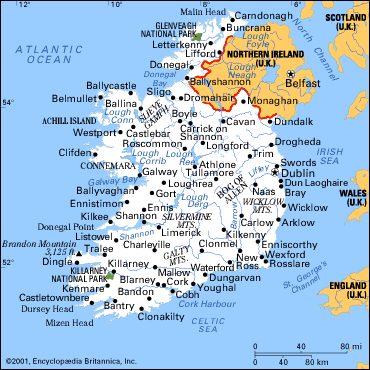

Dublin is the capital. It’s where you’ll likely land. The country is in western Europe, occupying most of the island to the west of Great Britain. The area is 27,459 square miles. That’s 71,118 square kilometers if you prefer metric. The population is estimated at 5,653,000 as of 2026. It’s not huge. But it feels bigger when you’re there.
You need to know the basics before you book flights. Ireland uses the euro. English and Irish are both official languages. Christianity is the main religion, with Roman Catholicism being dominant. Protestantism is present too. Ethnic distinctions are nonexistent. The country has been invaded and colonized by Celts, Norsemen, Normans, English, and Scots. But those histories have blended.
The landscape is mostly broad lowlands. The Shannon River drains much of it. The coasts are fringed with mountains. About three-fifths of the population lives in urban areas. Agriculture employs a small percentage of workers. High technology, tourism, and services drive the economy. Mining, manufacturing, and construction still matter.
Why Visit Ireland Now?
Ireland is a unitary multiparty republic. The president is head of state. The prime minister runs the government. It joined the European Economic Community in 1973. It’s now a member of the European Union. This matters for travelers. It’s accessible. It’s stable. It’s familiar yet distinct.
The history here is heavy. Settlement began around 6000 BC. Celtic migration started around 300 BC. St. Patrick Christianized the country in the 5th century. Norse domination started in 795. It ended in 1014 when Brian Boru defeated them. Gaelic Ireland’s independence ended in 1175. Roderic O’Connor accepted English King Henry II as overlord.
Things got complicated in the 16th century. Irish Catholic landowners fled religious persecution. They were replaced by English and Scottish Protestant migrants. The United Kingdom of Great Britain and Ireland was established in 1801.
Then came the Potato Famine in the 1840s. As many as two million people emigrated. About one million died from starvation or typhus. British relief measures were grudging and ineffective. This built momentum for Irish Home Rule.
Key Historical Sites for Travelers
The Easter Rising happened in 1916. The Anglo-Irish War followed from 1919 to 1921. The Irish Republican Army used guerrilla tactics. They forced the British government to negotiate. The Anglo-Irish Treaty was signed on December 6, 1921. Ratified by the Dáil the next month, it granted southern Ireland dominion status as the Irish Free State.
Internecine struggle broke out. The Irish Civil War lasted from 1922 to 1923. In 1937, the Free State adopted the name Éire. It became a sovereign independent country. It remained neutral during World War II.
In 1948, the Dáil passed the Republic of Ireland Act. It took effect in April 1949. Ireland declared itself a republic. It left the British Commonwealth of Nations. Britain recognized this. But it declared that unity with Northern Ireland could not occur without the consent of Northern Ireland’s parliament.
This is still relevant today. In 1973, Ireland joined the European Economic Community. It is now in the European Union. In the last decades of the 20th century, the political status of Northern Ireland caused hostilities. Catholics and Protestants clashed in the north. There were serious terrorist incidents in the south.
The Irish government played a pivotal role in the Good Friday Agreement (Belfast Agreement) in 1998. Ireland agreed to remove its constitutional claim to the entire island. This was enacted in 1999. Ireland continues to play a consultative role in Northern Ireland. It helped negotiate an agreement between the Democratic Union Party and Sinn Féin coalition government in 2010. Policing and justice powers were devolved to Northern Ireland’s government.
Practical Travel Info
Most of the population is urban. You’ll find services, hotels, and restaurants in cities like Dublin, Cork, and Galway. Agriculture employs only a small percentage of the workforce. But the countryside is still beautiful. It’s worth seeing.
High technology, tourism, and other service industries are pivotal to the economy. Mining, manufacturing, and construction remain important. This mix creates a dynamic environment. It’s not just postcards and pubs. It’s modern.
If you’re planning a trip, consider the timing. The weather can be unpredictable. Pack layers. The landscape varies from lowlands to coastal mountains. The Shannon River is a key geographic feature. It’s worth a boat trip if you’re into that sort of thing.
Currency is the euro. Credit cards are widely accepted. English is spoken everywhere. Irish is official but less common in daily use. Christianity is the predominant religion. You’ll see churches and cathedrals. They’re part of the cultural fabric.
Ireland’s history is complex. It’s layered. You can see it in the stones of its castles. In the names of its towns. In the conversations of its people. It’s a place where the past is never far away.
Why does this matter for a traveler? Because context enriches experience. Standing in Dublin, you’re standing on ground shaped by centuries of invasion, resistance, and resilience. The Easter Rising sites are significant. The sites of the Anglo-Irish War are historically important. The Good Friday Agreement sites in Northern Ireland offer a different perspective.
The Republic of Ireland Act of 1949 changed everything. It removed Ireland from the British Commonwealth. It made it a republic. Britain recognized this. But the question of unity with Northern Ireland remains unresolved. It requires the consent of Northern Ireland’s parliament. This is a key political detail. It affects travel plans if you’re crossing the border.
The Irish Civil War (1922–23) was brutal. It followed the Anglo-Irish Treaty. Supporters and opponents of the treaty clashed. This history is still felt. It