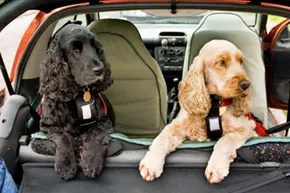
Your dog Max might dream of wind-in-his-fur road trips, but a trip to the dog park or a vet visit isn’t safe without proper pet protection. Whether you are taking a quick commute or a cross-country move, transporting pets is often necessary. Making your car pet-friendly offers obvious advantages for both you and your animal.
Your car was designed for humans. Unless you drive a model with specific pet-friendly options, the carpeting, upholstery, side panels, and ceiling liners are not built for claws, fur, or accidents. If you do not mind frequent detailing and vehicle rehab, a few scratches might not bother you. But the safety hazards? Those are serious.
In a moving vehicle, your pet is a dangerous distraction. Even if he stays quiet, his unsecured body can become airborne in an accident. This puts his life and yours at risk. Even a minor fender bender can make a frightened pet agitated and aggressive. A pet restraint offers an easy, humane way to protect and control your dog or cat.
Pets vary in size, destructiveness, and temperament. There are many seating and restraint options available. Some include enticing extras for the discriminating pet and devoted owner.
Safety Car Seats for Pets
There is more than one way to keep your pet safe in the car. Placing a pet in a dedicated carrier is one of the most secure methods. It works on multiple levels.
Cats are notoriously unruly and vocal when traveling. Enclosing them in a carrier helps control panicky scratching and contains the hair loss that often occurs when a cat becomes agitated. A carrier makes an effective temporary enclosure once you reach your destination. If the pet has an accident along the way, the mess is confined and easy to clean with a garden hose later. An enclosed carrier may not be much fun for your pet, though. This is especially true for well-behaved dogs who want to enjoy the sights.
To make traveling more fun and less like incarceration, a whole sub-class of secure seating products has emerged. Most use straps that attach to your car’s seatbelt system, the seat base, or the seat and center console. A chest harness keeps your pet from roaming. In case of an accident, it acts like a child restraint, distributing his weight on impact and keeping him confined.
In a collision, an unsecured pet can become a projectile. He can hurt you, other passengers, and himself. Even if an unsecured pet survives a vehicular accident, he could make it harder for others to enter the vehicle to help. He could also be hurt on the roadway after exiting your vehicle.
When selecting a safe seating system for your pet, choose a brand that has undergone rigorous testing, including crash testing. This can be tricky because currently there are no broadly recognized minimum durability standards for pet travel harnesses or safety seats. The emerging V9DT pet travel harness standard may be one to look to in the future, however.
In lieu of an established standard, rely on major brand names and endorsements you trust. Seats and harnesses may be sized based on your pet’s weight, general dimensions, or girth measurement. Although some harnesses are adjustable, choosing a snug but comfortably fitting harness (not just a collar) is one of the best ways to take full advantage of the safety features of your pet’s seat restraint system.
If you have a large or very muscular pet, you may also want to consider using a harness with metal rather than plastic fittings. Wide, heavy-duty nylon straps are also recommended. Harness styles can vary, too. They range from simple nylon straps to elaborate vests.
A simple harness may be enough to make your pet safe for a car ride. But his comfort and your convenience are also factors to consider. A lot of pet car seat designs on the market work in tandem with pet harnesses. They include:
- Plush pads
- Seat mounted carriers
- High-sided, fleece-lined dog beds
- Combo units that can convert from seats to strollers (or carriers)
The harness keeps your pet safe. The padding offers comfort and added cushioning during unexpected turns and stops. The onboard seating also protects your upholstery from punctures, scratches, and pet hair. If your pet experiences a bout of carsickness, the cushion or lining can be removed and laundered. Or hosed down for easy cleaning.
Although most pet car seats are easy to install in most vehicles, there are exceptions. Read the directions for the brand you’re interested in to make sure it will work in your vehicle. Check if it fits your bucket, bench, or custom seating.
Traveling with a pet roaming around the interior of your vehicle is a bad idea. Your pet is more than a nuisance when he tries to climb in your lap or explore the area around the gas pedal. He’s a safety hazard. More than 30,000 accidents a year are caused by unrestrained pets. In fact, according to a study conducted by the AAA Foundation for Traffic Safety, taking your eyes off the road for just two seconds can double your crash risk.
Did You Know?
Traveling with a pet roaming around the interior of your vehicle is a bad idea. Your pet is more than a nuisance when he tries to climb in your lap or explore the area around the gas pedal, he’s a safety hazard. More than 30,000 accidents a year are caused by unrestrained pets. In fact, according to a study conducted by the AAA Foundation for Traffic Safety, taking your eyes off the road for just two seconds can double your crash risk.
Shielding Upholstery from Claws and Accidents
Your car interior doesn’t have to smell like a wet dog after every road trip. If you want to keep the scent fresh and the leather intact, you need to pet-proof those seats. Claws poke. Bladders slip. It’s a risk.
Pet car seat covers act as a shield. They put a waterproof barrier between your animal and your upholstery. You aren’t just buying protection; you’re buying comfort. Many of these covers come with thick padding. Some even have thermal layers that reflect your pet’s body heat back at them. You can find them as simple pads, hammocks, blankets, or full-coverage couch-style wraps.
The hammock style is worth looking into. It secures to the front headrests or side straps. This creates a U-shaped enclosure. Your pet can’t slide off into the footwell. It contains the mess. It keeps the hair on the seat and off the floor.
Aesthetics matter too. Manufacturers aren’t just throwing materials together. You can get covers in various patterns. Some offer monogramming. Most are washable. Throw them in the laundry. Check the tag first, though.
Material choice changes the experience. Microfiber is popular. It looks plush. Pet hair lifts off easily with a vacuum or a damp cloth. But it traps heat. In summer, it gets hot. If your dog needs to stay cool, pick natural fiber like cotton.
These covers protect your seats. They do not save your pet’s life. For safety, you need a restraint. A harness. A car seat. Don’t confuse protection with safety.
A free-roaming pet is the third biggest driver distraction, according to AAA. You don’t text and drive. Don’t let an untethered pet cause an accident either.
Elevating the View for Small Companions
A Great Dane fits in the back of a sedan. He looks out any window he wants. A Chihuahua? Not so much. If your dog strains to see, or just whines from boredom, elevation helps.
Pet booster car seats solve this. They work like kids’ booster seats. They raise your pet to eye level with the windows. The view becomes interesting. The ride becomes entertaining.
These seats fasten to your seatbelt system. They anchor to the seat itself. They include fittings for your pet’s harness. The bottom is padded or inflated. It lifts your pet up. This setup fits smaller pets. Cats. Small dogs. Up to 25 pounds. They fit in the passenger seat or the back.
Some designs have storage pockets in the bottom. Others convert into carriers. A few even come with heating elements powered by the cigarette lighter. Expensive brands adjust in height. You find the perfect viewing angle.
Weight isn’t the only metric. A long, fluffy dog needs more room than a compact one. Stretch out. Choose the next size up. If you have two small pets, look for dual tethers. Keep them together in one carrier. Just check the minimum weight requirements. Make sure they can share the space safely.
Cleaning is key. The interior lining should come off for washing. There must be a waterproof barrier behind the padding. The exterior should wipe down easily. A sponge. A hose. Make it simple.
Since many of these double as carriers, look for handles. Look for access doors. Getting your pet in and out shouldn’t be a struggle.
Letting a dog stick its head out the window looks funny. It can lead to eye injuries or worse in an accident. Roll up the window. Turn on the AC.