


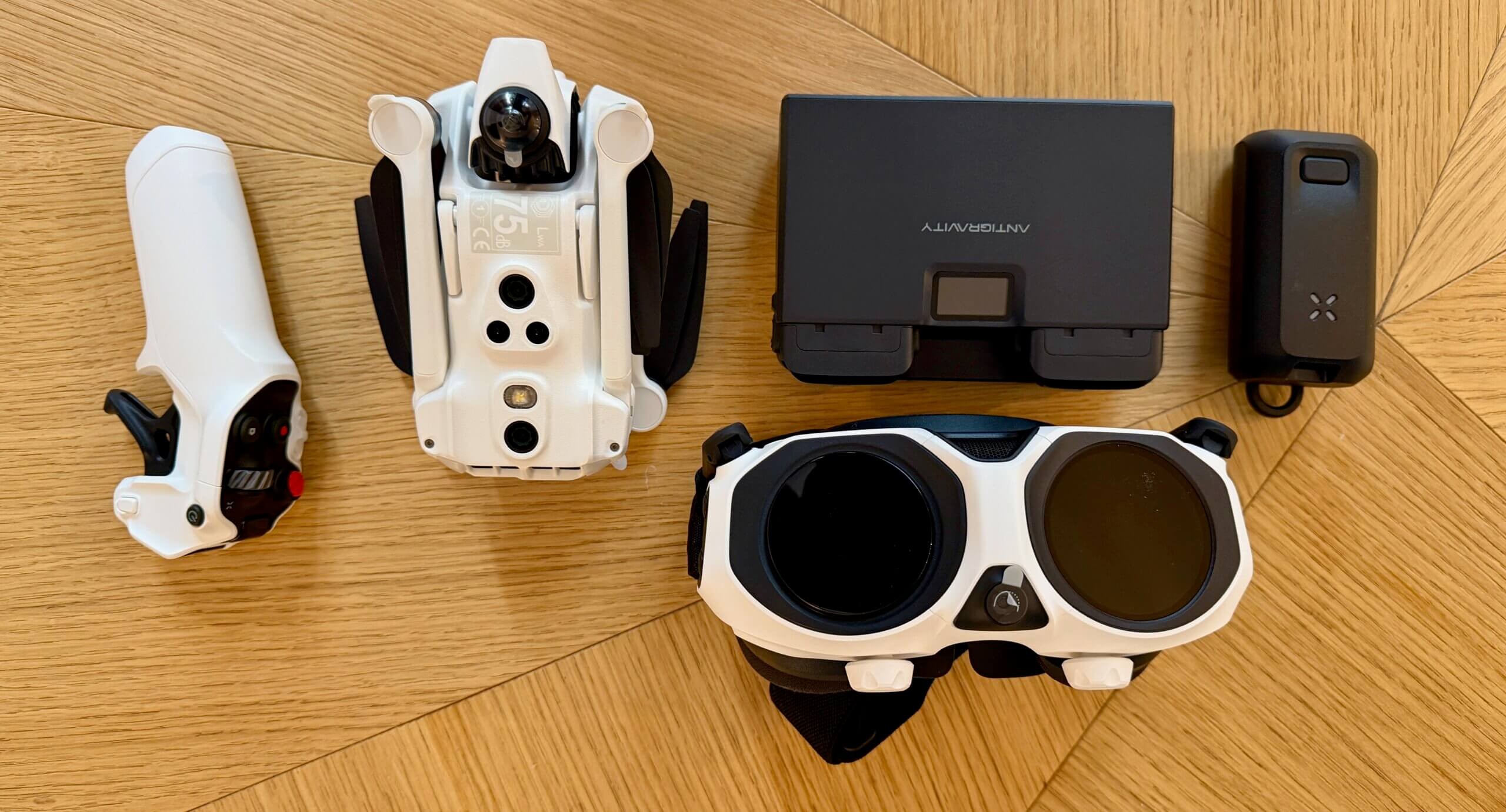
The drone market has long been divided into two camps: highly specialized FPV (First Person View) pilots who master manual acrobatics, and traditional camera drones that rely on mechanical gimbals to keep footage steady. The Antigravity A1, released in late 2025, seeks to bridge this gap by rendering the traditional gimbal obsolete through a “fly now, frame later” philosophy.
By utilizing a dual-lens 360-degree capture system, the A1 allows creators to focus entirely on flight, leaving the task of “framing” the shot to post-production.
360-Degree Capture: The “Invisible Drone” Effect
Unlike standard drones that feature a single forward-facing lens, the A1 utilizes two ultra-wide-angle lenses—one on the top and one on the bottom of the fuselage. Each lens boasts a 200-degree field of view, which, when merged, creates a seamless 360-degree spherical image.
This technology offers two massive advantages for creators:
– Zero Blind Spots: The drone captures everything in every direction simultaneously.
– Digital Erasure: Through advanced software, the drone itself is digitally removed from the footage, creating the illusion of a floating, invisible camera.
While the 1/1.28-inch CMOS sensors are slightly smaller than the 1-inch sensors found in professional photography drones, they are significantly larger than those in standard action cameras. This provides a crucial boost in low-light performance and dynamic range, helping to preserve detail in high-contrast environments like bright midday sun.
Designed for Compliance and Portability
One of the most strategic aspects of the A1’s design is its weight. In many regions, drones weighing 250g or more must undergo formal registration and adhere to stricter flight regulations. Antigravity has engineered the A1 to weigh exactly 249 grams with its standard battery, allowing users to fly without the burden of commercial registration.
Despite its lightweight profile, the build quality is robust. Constructed from a carbon-fiber-reinforced polymer, the A1 offers superior durability compared to the standard ABS plastics used in budget models. When folded, the device is roughly the size of a large smartphone, making it highly portable for travelers.
An Immersive Flight Experience
The A1 moves away from traditional piloting through two innovative interfaces:
1. Vision Goggles with Head Tracking
The included goggles feature dual 4K micro-OLED displays with a 120Hz refresh rate. Because the drone records in a full sphere, the goggles provide true spatial awareness. If you turn your head to the left, the feed pans left; look down, and you see the ground. This creates a level of immersion that fixed-camera drones cannot match.
2. Intuitive Motion Control
For most users, the A1 is operated via a single-handed motion controller. Instead of complex sticks, you simply point the controller to direct the drone and tilt your wrist to bank or climb. While professional “Mode 2” stick controllers are supported for FPV enthusiasts, the motion system makes flight accessible to novices.
Technical Performance and Editing
While the marketing highlights 8K resolution, it is important to note that in a 360-degree context, this resolution is spread across a full sphere. When “reframed” into a standard 16:9 video, the resulting crop is lower in pixel density than a native 8K camera. However, the color science—offering both a “Vivid” profile for social media and a 10-bit “Log” profile for professionals—is highly competitive.
The Antigravity Studio app further streamlines the workflow:
– Wireless Transfer: Speeds up to 80MB/s.
– Gyroscope Reframing: Users can “film” their shots by moving their phone around the footage.
– AI Auto-Frame: Automatically identifies and tracks subjects, acting as a virtual camera operator.
Practical Considerations: Battery and Flight Dynamics
The primary trade-off for this technology is battery life.
– Standard Battery: Offers approximately 19–20 minutes of real-world flight time.
– Pro Battery: Extends flight to 39 minutes, though it pushes the drone over the 250g weight limit.
While the A1 is not a racing drone—top speeds hover around 36 mph—it excels as a “cinewhoop” style flyer: stable, predictable, and smooth. It also features a “Turtle Mode,” which allows the drone to flip itself over if it crashes upside down, preventing a manual recovery mission.
Target Audience
The Antigravity A1 is positioned to serve three distinct niches:
– Extreme Sports Athletes: The “ActiveTrack” feature ensures the drone never loses a subject, even during sharp turns or under obstacles.
– Real Estate Videographers: Perfect for capturing seamless, sweeping interior tours of architecture.
– Travel Vloggers: Provides high-production-value aerial shots without the need for a dedicated camera crew.
The Antigravity A1 shifts the pilot’s focus from the technicalities of framing to the art of storytelling, bridging the gap between traditional cinematography and immersive VR.
Conclusion
The Antigravity A1 is a specialized tool that prioritizes creative freedom over manual control. While it requires careful handling and offers limited battery life, its ability to capture “invisible” 360-degree footage makes it a revolutionary choice for solo creators and adventurers.


