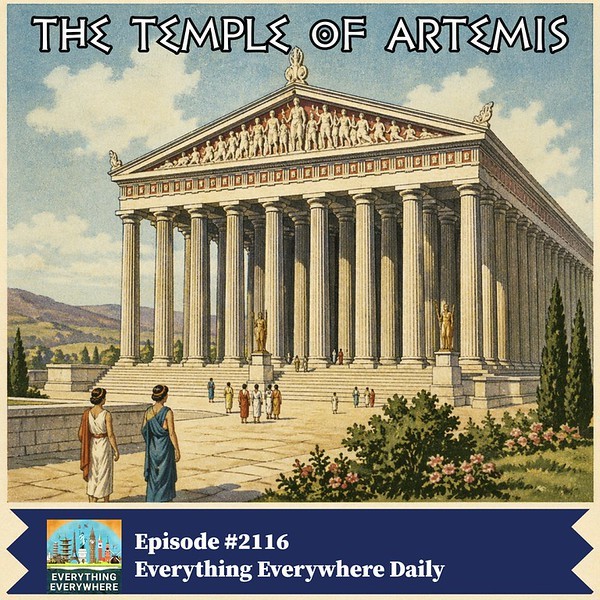
The Temple of Artemis at Ephesus was more than just a religious sanctuary; it was a marvel of ancient engineering, a massive financial powerhouse, and a symbol of imperial ambition. As one of the Seven Wonders of the Ancient World, its history is not a single linear story, but a cycle of magnificent reconstructions and devastating destructions.
A Sanctuary and a Bank
Dedicated to Artemis—the Greek goddess of the hunt, wilderness, and the moon—the temple served as the spiritual heart of Ephesus (located in modern-day Turkey). However, archaeological evidence, specifically the discovery of thousands of ancient coins, reveals a secondary, vital role: the temple functioned as a major financial institution.
Because of its sacred status, the temple was a trusted place to store wealth, making it a central hub for both religious pilgrimage and international commerce. This dual identity as a house of God and a bank made it both incredibly prosperous and a target for those seeking fortune.
Engineering Marvels on Marshy Ground
Building a massive stone monument on the soft, water-saturated soil of the Ionian coast presented a monumental challenge. To prevent the structure from sinking or shifting, ancient engineers employed a sophisticated foundation system:
– Charcoal Layers: Used as a buffer to absorb water expansion.
– Sheepskin: Placed over the charcoal to act as a dry barrier against impurities.
This ingenious method allowed a structure the size of a modern football field to remain stable for centuries, despite the region’s frequent earthquakes.
The Cycle of Destruction
The temple’s history is defined by three distinct iterations, each meeting a different kind of end:
1. The Arson of Herostratus (356 BC)
The second version of the temple met a bizarre fate. A man named Herostratus set fire to the temple not for political gain, but for pure vanity. He sought “Herostratic fame”—notoriety gained through a shocking act of destruction.
The fire was devastating because of how it was set; by saturating sacred fabrics with oil, the arsonist created a slow-burning fire that reached temperatures of roughly 800°C (1550°F). This caused calcination, a process where the marble loses its hardness and turns into a powdery, structurally unsound chalk.
2. The Gothic Plunder (262 AD)
The third and most magnificent version—described by Pliny the Elder as a masterpiece of Greek magnificence—was not destroyed by a single madman, but by an invading force. The Goths, seeking the temple’s legendary wealth, raided the site. They stripped the gold from the ceilings and emptied the treasury, treating the “bank” of Ephesus as a prize to be looted.
3. The Rise of Christianity (4th–5th Century AD)
The final blow was ideological. As the Roman Empire transitioned toward Christianity, the era of Greco-Roman paganism came to an end.
– 391 AD: Emperor Theodosius issued an edict banning pagan sacrifices and closing temples.
– 401 AD: St. John Chrysostom reportedly led a group of monks to physically dismantle what they viewed as “idolatry,” using sledgehammers and fire to topple the remaining columns.
A Vanished Wonder
By the time archaeologists began searching for the site in the 19th century, the temple had been almost entirely erased. Much of its stone was repurposed; some fragments were salvaged by the archaeologist John Turtle Wood, while others were used by the Byzantine Emperor Justinian to help construct the Hagia Sophia in Constantinople.
Today, only a few scattered stones and a single reconstructed column remain in the marshy landscape of Ephesus.
The Temple of Artemis stands as a testament to human ambition—a structure so significant that civilizations repeatedly poured their wealth and ingenuity into rebuilding it, even as the tides of religion and politics worked to erase it from the earth.