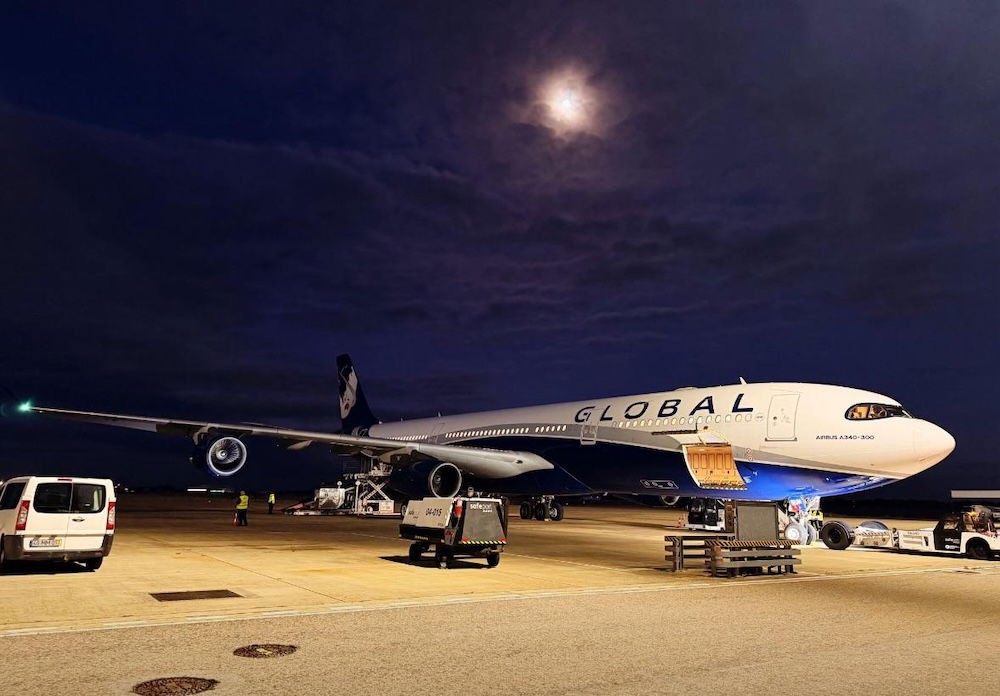
Global Airlines, the controversial airline startup, has once again drawn attention with a peculiar publicity stunt. The company recently shared images of an Airbus A340 bearing a “Global Airlines” decal, prompting speculation about a potential acquisition. However, the reality appears far more complex – and likely less substantial – than it seems.
The Context: A Startup Built on Questionable Foundations
Global Airlines has rapidly gained notoriety for its unconventional business model. The airline announced ambitious plans to operate Airbus A380s, an approach that industry observers have questioned given the aircraft’s high operating costs and the company’s limited resources.
This past spring, Global Airlines briefly operated four A380 flights with passengers, but these were conducted through a wet lease agreement with Hi Fly, meaning the actual operations were handled by another airline. The A380 is now in long-term storage awaiting expensive maintenance, a testament to the challenges facing this startup.
The A340 Decal: A Publicity Play?
The latest development involves an Airbus A340-300, registered as 9H-SUN, currently operated by Hi Fly. The aircraft now displays a “GLOBAL” decal along its fuselage, which Global Airlines shared on social media. This has raised questions: Did the airline actually acquire the plane?
The answer is almost certainly no. The A340 belongs to Hi Fly, a well-established wet lease operator, and the decal appears to be a temporary branding arrangement rather than a full livery change. This is not unusual for Hi Fly, which leases aircraft to other airlines as needed.
What’s the Point?
The A340 has recently flown to Antarctica and now operates flights for Surinam Airways between Paramaribo and Amsterdam, replacing a grounded wide-body jet. Global Airlines’ involvement seems limited to paying Hi Fly for the decal placement, likely to generate publicity.
The company has a history of vague communication and thrives on speculation. Its CEO has criticized misinformation but simultaneously engages in suggestive announcements without providing concrete details. The A340 stunt appears consistent with this pattern.
The move is likely intended to maintain some level of visibility, given that Global Airlines lacks its own air operator certificate and relies entirely on partnerships for flights.
Conclusion
Global Airlines has secured branding on a Hi Fly Airbus A340, but there’s little evidence of any meaningful operational change. The stunt serves as a publicity play, allowing the company to remain in the spotlight despite its questionable business practices. The arrangement is likely a temporary measure, with Hi Fly continuing to operate the aircraft as usual.