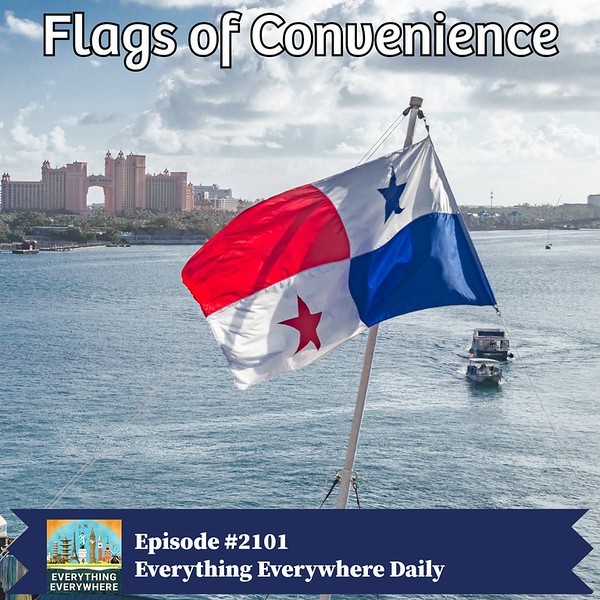
Every day, thousands of massive vessels traverse the world’s oceans, transporting the raw materials and finished goods that sustain the global economy. If you look closely at the stern of these ships, you will often see a flag that seems entirely out of place. A ship owned by a German company, carrying goods from China to the United States, might fly the flag of Panama or Liberia —countries it has never visited and may never touch.
This is not a mistake. It is a deliberate legal strategy known as a Flag of Convenience (FOC), a quiet but powerful system that dictates the cost, safety, and labor standards of almost everything we consume.
From Identity to Strategy: A Brief History
Historically, a ship’s flag was a simple identifier. In antiquity, banners signaled a fleet’s origin or helped distinguish allies from enemies in battle. By the Age of Sail, national ensigns became formalized, tying a vessel to a specific sovereign state and its laws.
The shift toward the modern FOC system began in the early 20th century. Driven by a desire to bypass domestic regulations, American shipowners began registering vessels in Panama during the Prohibition era to legally serve alcohol. Following World War II, this practice exploded. In 1948, Liberia established an “open registry” with significant American backing, offering a highly attractive regulatory environment. Today, Panama, Liberia, and the Marshall Islands dominate the industry, controlling nearly half of the world’s total shipping tonnage.
Why Do Companies Choose “Convenient” Flags?
The decision to reflag a ship is rarely about patriotism; it is a calculated move to optimize the bottom line. The primary drivers include:
- Labor Costs: By registering in an FOC nation, a company can bypass strict domestic labor laws. Instead of hiring domestic sailors at high wages with robust benefits, they can hire multinational crews from countries like the Philippines or India at significantly lower rates.
- Tax Optimization: Many open-registry nations do not tax foreign shipping income or charge only minimal flat fees based on vessel size, allowing companies to drastically reduce their global tax burdens.
- Regulatory Flexibility: Different nations have varying standards for safety, maintenance, and inspections. While not necessarily meaning a ship is “unsafe,” choosing a flag with lighter oversight can reduce the frequency and rigor of mandatory inspections.
- Anonymity and Liability: FOCs often allow for opaque ownership structures. By using shell companies across multiple jurisdictions, owners can make it much harder for regulators or victims of accidents to trace legal responsibility.
The Invisible Regulator: The Role of Insurance
If countries compete to offer the fewest regulations, one might wonder why the system doesn’t descend into total chaos. The answer lies in maritime insurance.
A ship can fly any flag it wants, but if it cannot be insured, it cannot operate. Major ports will deny entry, and cargo owners will refuse to use it. The global shipping industry is governed by a network of Protection and Indemnity (P&I) clubs —mutual insurers that cover massive risks like oil spills, collisions, and crew injuries.
These insurers act as the ultimate gatekeepers. They price their premiums based on risk; a ship flagged in a well-regulated registry like the Marshall Islands will pay less than one flying a flag from a country with a reputation for lax oversight. This creates a “floor” for safety: if a flag becomes too unregulated, the insurance costs become so high that the “convenience” is lost.
The Human and Legal Cost
Despite its efficiency, the FOC system is deeply controversial, particularly regarding human rights and domestic law.
1. Labor Exploitation and “Crew Abandonment”
The most persistent criticism involves the treatment of seafarers. Because ships operate under the laws of their flag state rather than their owner’s home country, workers often lack legal recourse. This has led to harrowing reports of low wages, grueling contracts, and “crew abandonment,” where shipowners facing financial ruin simply walk away from a vessel, leaving the crew stranded in foreign ports without pay or supplies.
2. The Jones Act and Domestic Protectionism
In the United States, the Jones Act of 1920 creates a sharp contrast to the global FOC model. To protect domestic industry, the Act requires that goods moved between two U.S. ports be carried on ships that are U.S.-built, U.S.-owned, and U.S.-crewed.
While this protects American maritime jobs, it creates logistical headaches. It is often cheaper to ship goods from the U.S. mainland to Hawaii or Puerto Rico by routing them through a foreign port (like Canada) rather than using a compliant, more expensive domestic vessel.
The Path Forward: Can the System Be Fixed?
Efforts to reform the FOC system have historically struggled because there is no global authority with the power to enforce uniform rules. Proposed solutions include:
* Strengthening “Genuine Links”: Requiring ships to have a meaningful economic connection to their flag state.
* Increased Transparency: Creating a centralized global registry to unmask the shell companies that hide true vessel ownership.
However, the incentive for change is low. Countries profit from registry fees, owners profit from low costs, and consumers benefit from the cheap goods that this system facilitates.
Conclusion
The Flag of Convenience system remains a fundamental, albeit controversial, pillar of globalization. As long as the industry prioritizes cost-efficiency and regulatory flexibility, the practice of flying “displaced” flags will continue to underpin the movement of global trade.