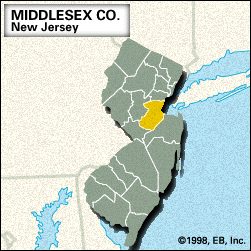
Middlesex County sits in the east-central heart of New Jersey, bounded by the Millstone River to the southwest, the Raritan River to the northwest, the Rahway River to the northeast, and Raritan Bay to the east. It is largely coastal lowland, dotted with lakes like Carnegie and Farrington, and crisscrossed by the South River. If you are looking for green space, the county’s oak and hickory forests offer a quiet escape. Cheesequake and Edison state parks are the go-to spots for hiking, boating, or just breathing air that hasn’t been filtered through an office HVAC system.
A County Forged in Revolution and Innovation
This isn’t just a suburb with a nice commute. Middlesex was formed in 1683, one of New Jersey’s original counties. It takes its name from Middlesex, England, but its soul is distinctly American. In the 17th century, Dutch settlers bought land from the Delaware Indians. They weren’t alone. Scottish, English, and French families followed, creating a patchwork of early white settlement.
The American Revolution turned this landscape into a battlefield. Several military engagements took place here. You can still feel the weight of that history if you look closely at New Brunswick, the county seat. It sits at the terminus of the Delaware and Raritan Canal, completed in 1834. New Brunswick is also home to Rutgers, the State University of New Jersey, founded in 1766. The university anchors the local culture, bringing students, professors, and a pulse to the downtown area.
Where Industry Meets Daily Life
Further north lies Perth Amboy. It served as the capital of the East Jersey colony from 1686 to 1702. Later, it became a provincial capital. Today, it connects to Staten Island, New York, via a bridge. It was also the northern terminus of the Camden and Amboy Railroad, completed in 1834. Railroads and canals moved goods. Now, cars and ferries move people.
Then there is Edison. Specifically, Menlo Park. Thomas A. Edison maintained his laboratories there from 1876 to 1887. This is where he invented the phonograph in 1877 and the incandescent lamp in 1879. He produced hundreds of other items in this small corner of the county. You don’t need to be an engineer to appreciate the sheer volume of innovation that happened here. The county seat is New Brunswick. The city named after the inventor is Edison. Two names. Two legacies.
The Modern Economy and Community Vibe
Other communities define the county’s daily rhythm. Woodbridge, Piscataway, East Brunswick, and Sayreville are among the populated hubs. The economy runs on three pillars: manufacturing (especially chemicals), services (business and health), and trade (retail and wholesale). It’s a working county. It’s not a tourist trap. But that doesn’t mean it’s dull.
The area covers 311 square miles. The population was 750,162 in 2000. By 2010, it had grown to 809