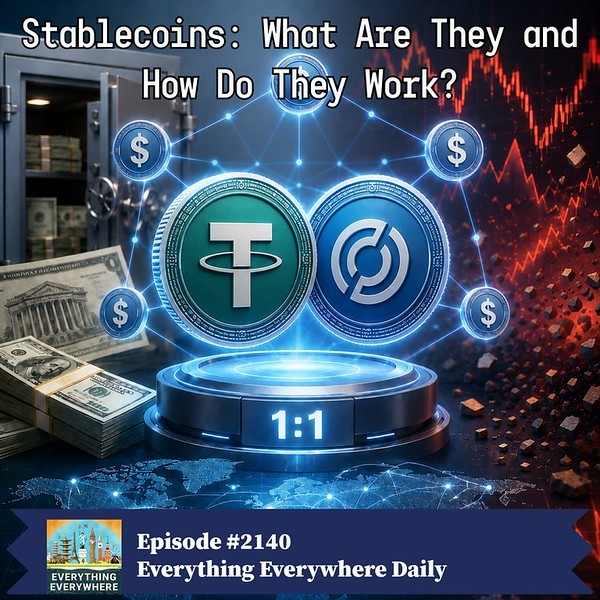
One of those financial terms everyone buzzes about.
Stablecoins.
They sound boring. Which is probably why they are terrifying. Banks and governments are staring at them. Tech giants are circling. But most of us have no idea what they actually are.
First, a complaint.
I hate the word “crypto.” It is a sloppy umbrella term. It lumps Bitcoin together with… well, everything else.
Bitcoin is decentralized. Rigid on supply. Digital gold.
Stablecoins? They are nothing like that.
A stablecoin is a digital token pegged to a fiat currency. Usually the US dollar. For this discussion, let’s stick to dollars, because that’s where the action is.
To understand why stablecoins matter, you have to look at the cracks in the old system. The banking system is ancient, slow, and expensive.
The Broken System
Send $500 to the Philippines? Good luck.
You will pay $15 to $40 in fees. You will get hit with a 2% to 4% exchange rate markup. You will wait days. The money hops between correspondent banks, with each one taking a cut before it lands in the recipient’s account.
In the age of fiber optics and satellite networks, money moves slower than physical mail. It makes no sense.
Then there is inflation.
In countries like Argentina, Turkey, and Venezuela, local currencies have evaporated. Losing 50% or 90% of your savings is not a hypothetical scenario; it is reality.
People want to hold dollars. They want stability.
But opening a US bank account? Hard for an ordinary person in Caracas or Istanbul. And when they do have dollar accounts locally? The government often forces them back into the crashing local currency.
Online commerce is stuck too. Credit cards dominate, but they come with high fees for merchants, fraud risks, and a monopoly by a few companies. Plus, banks sleep. They observe holidays. They respect time zones.
The internet doesn’t sleep. Money should not either.
Enter Stablecoins
A stablecoin is worth exactly one dollar. Always.
It is not an investment. You buy it to park money, not to get rich.
How does it stay at $1.00? Arbitrage.
If the price dips to $0.99, traders buy the discount tokens and redeem them for $1 cash. This buying pressure pushes the price up.
If the price hits $1.01, creators mint new tokens at cost and sell them at a profit. Selling pressure pushes the price down.
The mechanism works because stablecoins are backed. One-to-one.
If a company issues $1 billion in stablecoins they must hold $1 billion in assets. Usually short-term US Treasury notes. Some cash.
100% reserves.
This is where the rub with banks starts.
The Reserve Problem
Banks do not keep 100% of deposits on hand.
They use fractional reserves. They lend out most of the money to make profits. If everyone showed up on a Tuesday asking for cash at the same time? Bank run. Panic. Jimmy Stewart giving a speech. Remember?
With a fully backed stablecoin? Theoretically, everyone can cash out.
Yes, there might be friction if they have to dump Treasury bonds during a panic. But the liquidity is there. The promise is stronger.
This matters because of accessibility.
A stablecoin wallet is just an app. It requires internet, not a branch. It works 24/7. No holidays. No borders.
Merchants love this. Credit card fees eat 1.5% to 1.5% of sales. Stablecoin fees? Almost zero.
They even handle microtransactions. Pennies. Fractions of cents. Programmatic trading becomes possible in a way credit cards never allowed.
Why Governments Care
You might think the US government hates decentralized finance.
Wrong. They like stablecoins. Why?
Treasury bills.
Stablecoin issuers need to back their tokens with safe assets. They buy billions of US debt. This creates a massive, predictable buyer for American bonds. Lower borrowing costs. Easier deficit spending.
Estimates suggest this demand could reach $1 trillion by 2028 💰.
There is also soft power. Dollar stablecoins keep the dollar dominant. They pull global digital finance into US regulatory frameworks. Washington smiles at this.
How They Make Money
If they just hold Treasuries, where is the profit?
Interest.
The issuer keeps the yield from the bonds. The holder gets the stable price.
If you hold $100 billion at 4% interest? That is $4 billion a year.
Minus compliance, tech, and legal bills, of course. But it is a margin business with incredibly low marginal costs for additional transactions.
They also sell services. Payment APIs. Developer tools. Custody. The stablecoin is the loss leader that drags you into a larger financial ecosystem.
The Big Two
It is not a crowded market. Two names dominate.
Tether (USDT). The biggest by far. Around $190 billion in play.
It runs the global trading volume, especially in emerging markets. But Tether has a shadow over it. For years, it refused clear audits. Skepticism runs high. Is it really backed 1:1? Or is there riskier stuff hidden in the reserves?
USDC (Circle). The nice cousin.
Transparent. Licensed. Regulated. The preferred choice in US environments and decentralized finance (DeFi).
But even USDC had a scare. In March 2023, it briefly lost its peg. Circle had $3.3 Billion sitting at Silicon Valley Bank when SVB collapsed.
Panic ensues. Price drops. FDIC steps in to save bank deposits. Price recovers.
It was a reminder: “Backed by cash” only matters if the bank holding that cash is open. 🏦
The Downsides
Not everything is sunshine.
Currently, stablecoin holders cannot earn interest legally. Traditional banks hate this. They argue: “If you are competing with us, you should become us.” They want strict rules. Higher barriers to entry.
Then there is the regulatory vacuum.
The industry is new. There are no case laws. No clear statutes. Investors wait. Businesses wait.
Transparency remains a flashpoint. Can issuers prove they have the money? Tether says yes. The market demands proof.
And interoperability.
You cannot just swipe a Tether to a Circle wallet. They are separate networks. Bridging them requires intermediaries. More friction. More points of failure.
Who Needs This?
If you live in America, you probably do not need stablecoins today.
Your banking works. It is slow, yes. But it works.
The benefits flow to institutions first. Faster clearing. Cheaper settlements. Things you see on backend ledgers, not in your consumer app.
The real users are those locked out. The Venezuelan grandmother. The freelancer in Kenya. The merchant tired of swipe fees.
The End Game?
Adoption is low. The technology is rough around the edges.
But the potential is structural.
Stablecoins bypass banks. They make correspondent banking obsolete.
And this might just be step one. Imagine stocks tokenized. Bonds tokenized.
24/7 global trading. Instant clearance.
Banks have stood for centuries. They are conservative. They resist change.
But disruption does not care about tradition. The infrastructure is there. The money is there.
What happens next depends on whether the regulators crush the innovation or adapt to it.
We will see. 👁️